
Painted Progress: Clerical Portraiture and Secularization in Petrine Russia
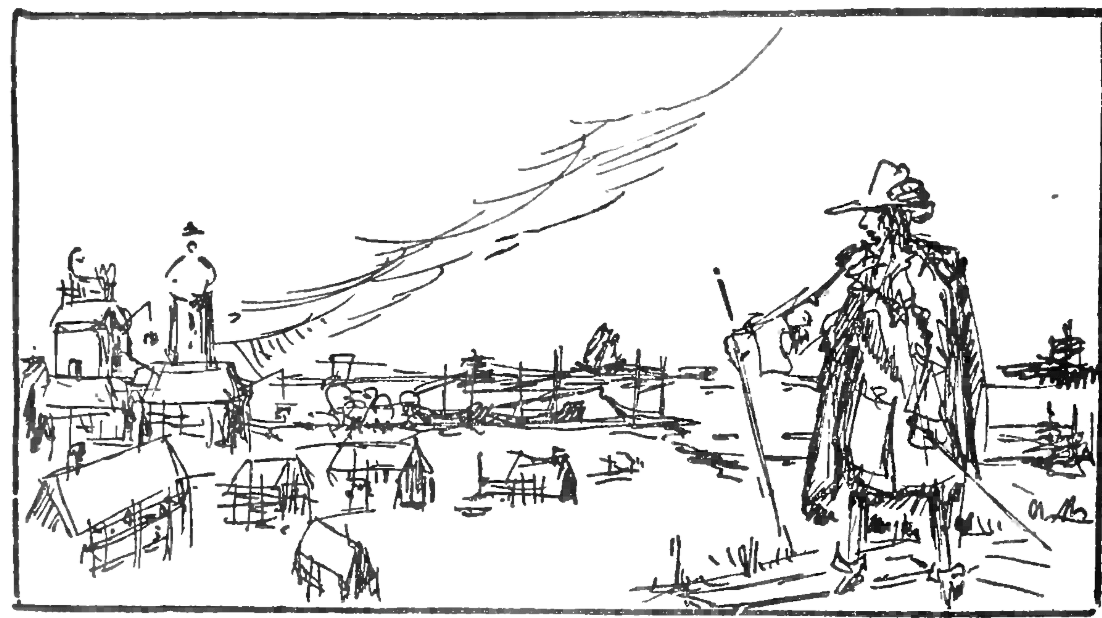
Peter the Great Builds His New Capital, Hendrik Willem Van Loon, 1921
By Eamon Maloney, Georgetown University
During Peter the Great’s sweeping transformation of Russia in the 18th century, the Russian Orthodox Church was arguably affected more than any other part of Russian society. Before Peter, the patriarch of the church could be compared in terms of influence to a second head of state. However, Peter the Great’s foreign interests and desire to model Russia on a European system saw the church lose part of its role in state affairs and come into direct conflict with Peter on several occasions, such as when Peter blocked the publishing of Archbishop Stefan Yavorsky’s Rock of Faith, a book pleading for the independence of the church from the state. The extent to which this bureaucratic change led to the secularization of the Russian government or the neutering of the Church is still debated by scholars. The prevailing belief is that the Church was subordinated to Peter’s new government as a servant of the state. Other scholars, such as G. L. Freeze, argue, however, that the Petrine reforms did not subsume the Church into the state bureaucracy, and that subsequent state efforts to do so throughout the imperial period actually galvanized the clergy into a distinct force with its own political interests.
This paper navigates these claims by analyzing the era's portraiture to examine how the Church and Peter developed their own identities through visual imagery. Portraiture, the visual representation of a person’s likeness, mood, and personality, has proven to be a rich source for examining social change and personal motivations. For instance, Lindsney Hughes' 2008 article "From Tsar to Emperor" provides an easily visible method of this evolution through comparing Tsar Aleksei's (1629-1676) portrait with Peter I's (1672-1725). While Aleksei’s portrait retains much of the flat, iconic imagery one might expect of the Muscovites, Peter’s more life-like, detailed portrait contains great depth and a lack of religious symbols more fitting of the Western, secular ruler he may have hoped to embody. Alternatively, Richard Wortman’s Scenarios of Power shows how rulers can use art and ritual as instruments of social change. Lina Bernstein’s analysis of 18th-century merchant pictures shows how individuals built their identities and values through the core symbols within their portraits. Building on these methods, a comparison of the portraiture of church officials through the pre-Petrine and post-Regulation eras reveals how Peter the Great crafted a personal image distant from the church, while the heads of the clergy embraced a humbler institutional identity no longer equal to the tsar.
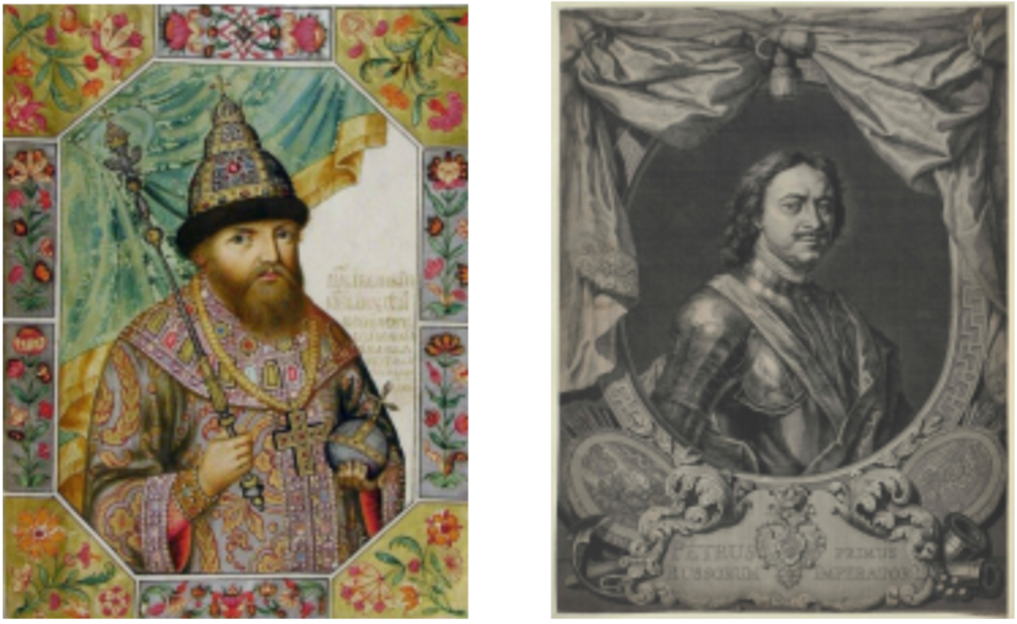
Portrait of Aleksei Mikhailovich (1672) Engraved Portrait of Peter I (1718)
As Hughes demonstrates, comparing the portraits of Tsar Aleksei and his son, Peter I, immediately reveals the stark contrast in personality and rule between the two monarchs. Aleksei's portrait remains firmly within the Byzantine, iconic style that characterized tsarist portraiture before Peter’s reign: he is dressed in traditional Russian monarchical garb, adorned with religious symbols, bearded, and rendered with the same impassive facial expression found in portraits of his predecessors. Peter I’s portrait, on the other hand, embraces the more modern, European style. The engraving has significantly more depth and detail, with his expressive face and layered hair and armor. However, it is not just the artistic style but the symbolic nature of the painting that shows the massive differences between these two rulers. Peter I is adorned with clothing more reminiscent of a European knight than a Russian tsar. He carries none of the traditional Russian monarchical regalia, such as the scepter or orb, and religious symbols like crosses are absent. Though this portrait may not be Peter's most iconic image, it dates to the period after his victory in the Great Northern War, one of his defining achievements, and coincides with the height of his governmental reforms. Any portrait commissioned during this window offered a chance to align the tsar's image with the new Russia he was building. The deliberate departure from conventional monarchical symbols and religious iconography reveals just how far Peter's priorities had already diverged from his father's.
This secular nature of Peter’s image was not unique to the portrait, though, as the clergy felt some of the most profound effects of Peter’s reforms. Peter's 1721 Spiritual Regulation transformed church governance to mimic the European colleges, replacing the patriarch with the Holy Synod. Scholars debate how much this diminished ecclesiastical authority. Freeze notes that the Synod's elevation to peership with the Governing Senate gave it considerable institutional standing. What the Regulation did unambiguously was redefine the terms on which clerical authority could be displayed.
In his Regulation, Peter lists several reasons as to why the establishment of the Spiritual College is necessary, but perhaps most telling of these reasons is that it will prevent “revolts and disturbances from a conciliar administration such as proceed from a single, independent ecclesiastical administrator,” which might occur as a result of the people being unable to understand “how the spiritual authority is distinguishable from the autocratic; but marveling at the dignity and glory of the Highest Pastor, they imagine that such an administrator is a second Sovereign, a power equal to that of the Autocrat, or even greater than he.” This point, saved for last on Peter’s list, clearly puts space between the patriarch and the tsar.
Peter’s distant relationship with the church extended beyond his Spiritual Regulation, as is seen in the portrait of Peter contrasted with Aleksei; it was also seen in his personal image. Examining a pre-Petrine portrait will help us understand what this looked like and the changes that occurred on an ecclesiastical level during Peter’s reign.
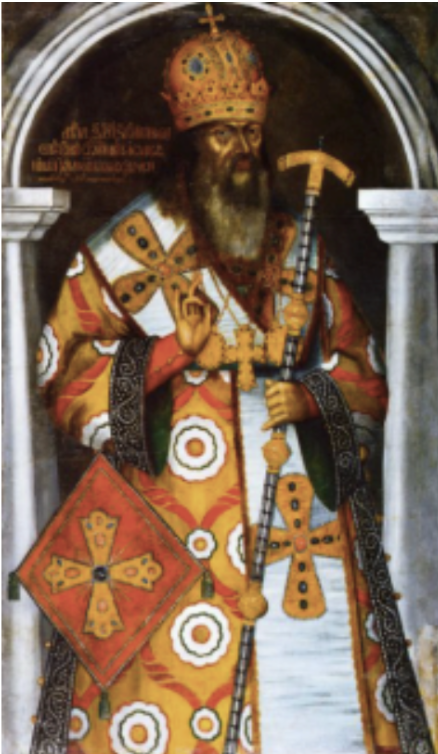
Portrait of Patriarch Joachim (1678)
The portrait of Patriarch Joachim of Moscow (1620-1690), seen above, is a prime example of a pre-Petrine painting. Patriarch Joachim was important in his own right in the history of the Orthodox Church, especially for his role in helping to reunite the Ukrainian Orthodox Church with the Russian. It is important to note that Joachim held a great deal of influence, as did his predecessors. Foy de la Neuville, a traveller through Muscovy, noted in his contemporary account A Curious and New Account of Muscovy that Joachim played a role in Peter’s overthrow of Princess Sophia. Joachim, likely a supporter of Peter, intervened in the coup to cease the bloodshed, and would also later act as a short-lived mediator between the two parties on Sophia’s later attempt to regain power. Additionally, Neuville claims that Sophia wanted to replace Joachim with a different priest. This close involvement shows the power of the Patriarch went far beyond the walls of a church, even up to the start of Peter’s rule.
Looking at the portrait of Patriarch Joachim only adds to this narrative. Here we see the Patriarch clothed in elaborate robes, rich with detail and symbols. Around his neck lies a panagia, a medallion traditionally with icons (although not pictured here), and a cross. On his head rests an elaborate mitre, modeled on the Byzantine imperial crown, which is embedded with jewels and icons. Comparing this portrait with Aleksei’s, one of the same era, it may be easy to “imagine that such an administrator is a second Sovereign,” as the later Spiritual Regulation put it. Both are heavily robed and adorned with religious imagery and jewels, but while Aleksei holds the scepter and orb of Russian tsars, Joachim holds the crozier of an Orthodox priest in one hand and does the sign of the cross with the other. Comparing these two portraits may make it even easier to see why Peter was worried about the confusion of the two rulers; the line between tsar and patriarch was very thin.
Despite playing an important role in aiding Peter the Great’s seizure of sole power, Joachim was not a blind supporter of Peter’s policies. Distrustful of foreigners, Joachim was against Peter’s policy of insisting upon bringing Europeans to Russia as part of his westernizing agenda. Joachim did not see a world in which Russia benefited from non-Orthodox members being admitted into the society, much less at the highest level, whereas Peter openly invited Lutherans, Protestants, and Catholics to advise him. When Joachim died in 1690, his successor and close friend, Adrian, was elected, somewhat to Peter’s chagrin. Patriarch Adrian (1638-1700), the last Patriarch of Moscow before the establishment of Peter’s Spiritual College, had a tenuous relationship with the tsar. His time as patriarch coincided with Peter’s reign, and although Adrian was forced to accept some of Peter’s reforms, he also pushed back against many of his actions. However, despite this pushback, Peter ultimately retained final say.
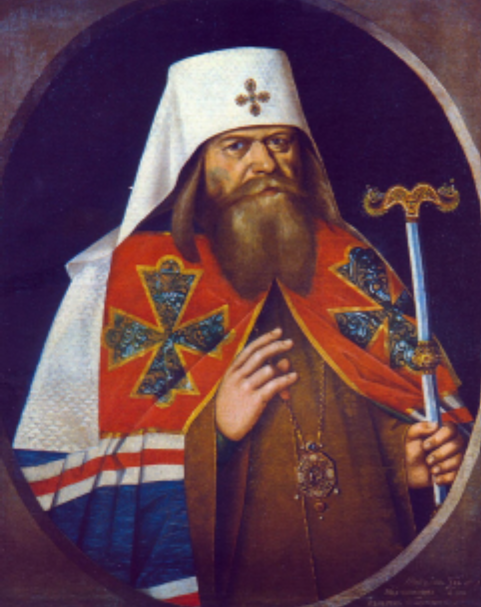
Portrait of Patriarch Adrian (Start of 18th Century)
Viewing a portrait of Adrian reveals a sharp contrast with his predecessor, Joachim. For one, while the image is still quite flat and reminiscent of iconography, the symbolic content of Adrian’s clothes is much more toned down. Only his single panagia and crozier are bejeweled, and in place of the mitre, Adrian wears a white koukoulion, as is traditional for Eastern Orthodox patriarchs. The white koukoulion is actually more common in the broader history of Patriarchal portraiture, although it became more frequent in the years leading up to Joachim. The fact that the crown is now removed is a symbolic representation of Adrian’s conservative stance, but also the church’s developing distance from the tsar. The only man fit for royal imagery now is Peter. While Adrian's robes have patterns and symbols embedded in them, they are significantly plainer than those of his predecessors. Additionally, the absence of background in Adrian's portrait foregrounds the symbols of the cross and panagia, isolating the religious identity of the patriarch without anything grander. The contemporaneous portrait of Peter below, produced shortly after Adrian’s death, helps to visualize the differing priorities of church and state already early in Peter’s reign. Comparing the two shows that the line between tsar and priest was becoming much stronger.
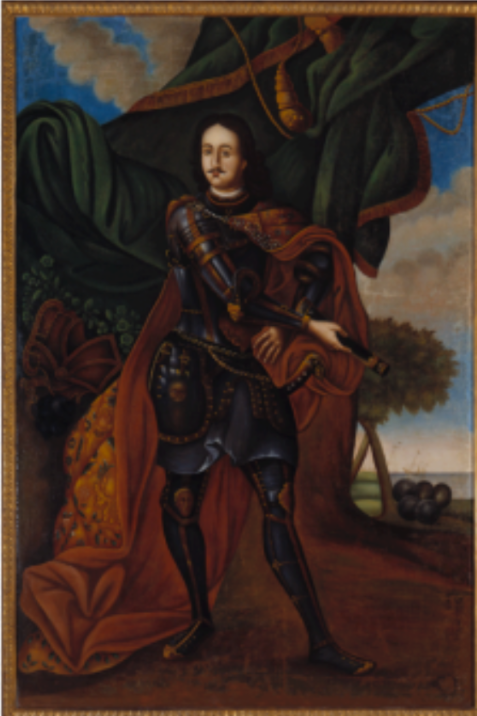
Portrait of Tsar Peter Alekseevich (1702)
This portrait, made to commemorate one of the first victories of the Great Northern War, shows Peter in full military regalia. The iconic style reflects the purpose of this painting–to decorate the church of the New Dvina Fortress in Arkhangelsk. His elaborate armor of cold steel projects the image of a wartime leader. The portrait also uniquely contains motion, showing Peter lowering a looking glass towards the hand on his hip, resting right above his sword. The elaborate background of the portrait, depicting the victorious tsar at the flag bastion of the fortress, with cannonballs by his feet, soldiers’ tents, and half-sunk Swedish ships in the background, only adds to the powerful image of the tsar. Peter’s portrait, despite even being produced for a church, is absent of religious imagery. The detailed backgound gives Peter more temporal, physical authority, as compared to Adrian’s, who is isolated. Peter was often involved in the shaping of his image, and the tsar likely played a role in choosing the imagery of this portrait, and it was notably made after Peter chose not to elect a new patriarch. The decision to abandon the traditional religious imagery, especially in one commissioned for a church, shows an active distancing from the church by Peter. This shift is corroborated by contemporary accounts of Peter’s “All-Drunken Council,” a mock ritual that included heavy drinking and a mock patriarch.
While historians debate the intentions of this council as an act of secular defiance against the church, when considering it side-by-side with Petrine portraits that almost completely lack religious imagery, it is clear that Peter was beginning to develop an identity separate from the church, and this portrait is a clear step in how he wished that he would be portrayed. The contrast in style and imagery is especially evident when compared with Adrian’s, which foregrounds the religious imagery while leaving out a background and embellishment on his robe; it is evident where each institution's priorities lie.
Upon Patriarch Adrian’s death in 1700, Peter the Great did not permit the election of a new patriarch, and in 1721 would officially abolish the Patriarchate with his Spiritual Regulation. In the time between, Archbishop Stefan Yavorsky ruled locum tenens. Although Yavorsky was initially hesitant to rule, it was at Peter’s insistence that he assumed the role. Yavorsky was thus thrust into a strange new position, unsure of how he was meant to proceed and with what resources. At the time, Peter was abroad in the Baltic, fighting the Great Northern War, and Yavorsky had to (reluctantly) assume control of an office that had just had its head cut off after 100 years of service. Whether Yavorsky’s reluctance to assume control can be attributed to modesty or a sense of uncertainty in ruling, Peter certainly thought that Yavorsky was the right choice. An extremely well-educated man with considerable literary talent, Yavorsky’s quiet nature meant that he was a strange choice for the head of the church under the bombastic reign of Peter. In a letter to a friend in 1707, Yavorsky complained that “the man who has lived happily is the one who has been able to hide himself away.” Despite this longing for solitude, Yavorsky was not afraid to voice his beliefs, clashing many times with the tsar over his ecclesiastical reforms and demands. Besides his dislike for his post, he wrote several pointed theological works that put him increasingly at odds with Peter's reforms, most notably his Rock of Faith, a defense of Orthodox tradition that Peter suppressed and which would not be published until after both men were dead.
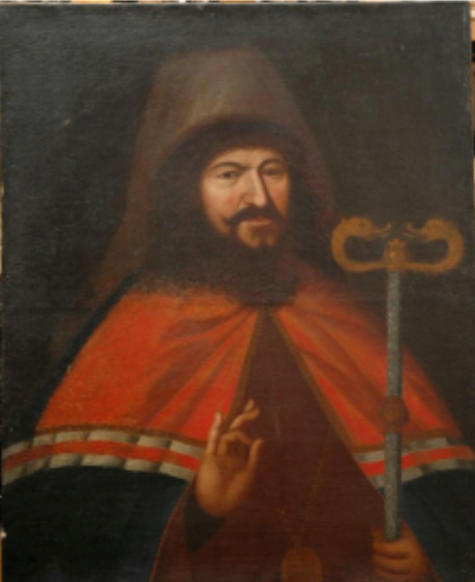
Portrait of Stefan Yavorsky (18th Century)
While the letters and works of Yavorsky are difficult to access, especially in translation, the modesty and subtle resistance that helped define Yavorsky’s tenure can still be viewed in his portraiture. This restored 18th-century portrait continues the scaled-back symbolism represented in Patriarch Adrian's portrait to an even greater extent. Yavorsky’s robes are now plainer. The panagia around his neck is simple, undetailed. He still holds the crozier, albeit much less dazzling. He wears a white koukoulion, traditionally reserved for patriarchs; however, unlike Adrian’s, his headdress lacks any detailing at all, a small but still noticeable step back in cosmetic profusions for the church. This portrait shows how the patriarchy was beginning to move towards portraying itself in a more conservative light. Comparing this with a portrait of Peter from the same period, perhaps the most famous image of the Tsar, shows the increasing rift between how the church and state each wished to be portrayed.
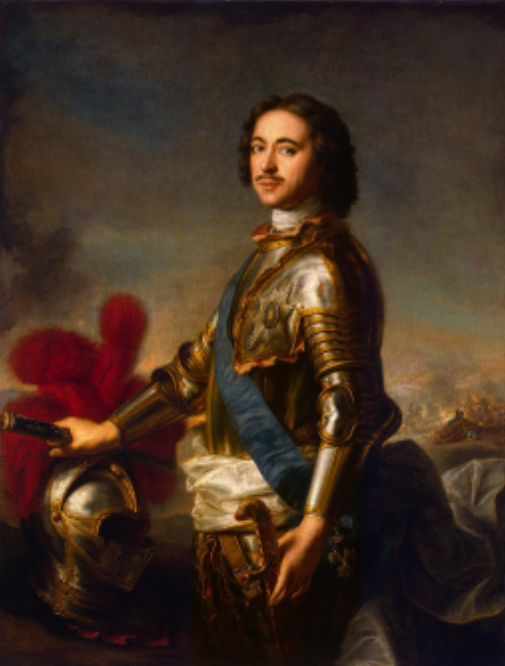
Portrait of Peter I (1717)
This 1717 portrait of the tsar by Rococo French painter Jean-Marc Nattier is one of the definitive visual representations of Peter I and the core values of his reign. Painted in Amsterdam, the painting fully embodies the modern, European style that Peter wished to imitate. Matching the grandeur and style of contemporary monarchical portraits such as Louis XIV’s, Nattier’s rendition of Peter provides an even more intimate look. The depth and style of this painting are a massive leap forward in terms of artistry compared to both the engraving and the iconic style of 1702, foregrounding Peter with scenes of battle against smoke in a wide sky. Besides the elaborate detail of Peter’s battle armor and physiognomy, the symbols of Petrine rule and tsardom are more evident here, unlike before. On his hip, Peter carries a small medallion with the imperial eagle and cross. One hand rests at his hip by a bejeweled dagger, while the other rests on his helmet, holding the imperial scepter. On Peter’s armored chest is a metallic star version of the Order of St. Andrew with accompanying sash, established by Peter himself in 1698. These elaborate and subtle symbols of the Russian imperial order take the picture of Peter from beyond a man in a suit of armor to the preeminent ruler of Russia, an elegant and noble warrior.
Although made not too far apart timewise, this portrait of Peter contrasted with Yavorsky’s paints the picture of two entirely different worlds. The reluctant Yavorsky is a symbol of modest, quiet penitence, while Peter, in all of his elaborate glory, embodies the modern, Western ruler. This contrast is even stronger when combined with the fact that Yavorsky was made to stay in his position whilst Peter went abroad, sending him reports of his victories and requesting him to preach sermons about them.17 Peter’s earlier Arkhangelsk portrait can be seen as an earlier test of the newer European style, while this portrait represents its apex. Peter loved this painting so much that he invited Nattier to St. Petersburg as part of his Grand Embassy to disseminate European ideals further; however, Nattier refused. Still, this painting was influential in its own right, sparking a new wave of European rulers who hoped to be portrayed in their military attire. The new, secular image Peter was actively crafting, while the church remained somewhat stagnant in its portrayal since Patriarch Adrian’s, reveals the diverging priorities between the tsar and the church. However, Yavorsky’s tenure as head of the Holy Synod was short-lived, and a new leader with more drastic reforms in mind would soon take his place.
Following Yavorsky’s death in 1721, Peter appointed a more ideologically aligned successor in Feofan Prokopovich (1681 - 1736). Prokopovich, the former archbishop of Novgorod and primary author of Peter’s Spiritual Regulation, stands as one of the most paradoxical figures in the Petrine ecclesiastical landscape. Born an orphan in Kyiv and raised by a learned monastic uncle, Prokopovich completed the Kyiv academy's full course before studying at Jesuit colleges in Poland and Rome. It was his preaching that first brought him to Peter's attention. Following the victory at Poltava in 1709, Prokopovich delivered a celebrated panegyric to the tsar that was published in Slavonic, Polish, and Latin “so that the whole of Europe should know of this triumph.”1 Called to St. Petersburg in 1715, he became Peter's closest ecclesiastical collaborator. Unlike Yavorsky, who embodied quiet institutionalism, Prokopovich was an ideological ally of the tsar, though scholars like Freeze have argued his theology was unqualifiedly Orthodox rather than a Westernizing departure from tradition. What his portrait and the Regulation suggest is that even within an Orthodox framework, Prokopovich helped form the church ideationally in a newer, subdued image.
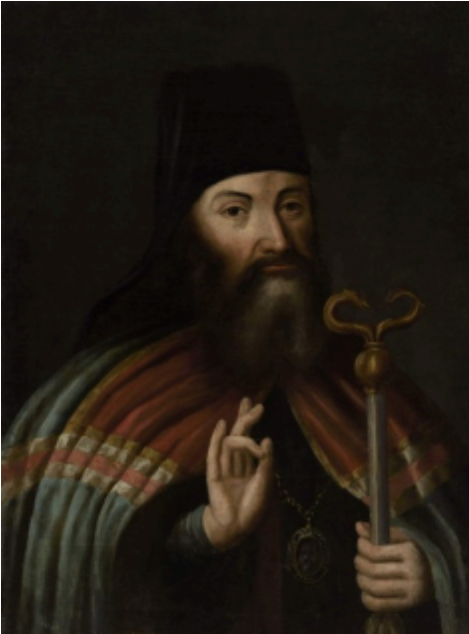
Portrait of Feofan Prokopovich (18th Century)
While Yavorsky can be seen in many ways as an opponent to Peter, Prokopovich was a close ally. However, despite being ideologically opposed, Prokopovich and Yavorsky’s portraits are nearly identical. While Prokopovich’s is slightly more modern, with better depth and detail, the pose, facial expression, and clothing are the same. The main difference is that Prokopovich wears the black klobuk, compared to Yavorsky’s white. However, while Adrian and Yavorsky’s portraits reflect an unofficial step back in church power, Prokopovich’s solidifies the standard. Prokopovich’s personal closeness to Peter does not mean that he sees himself as equal to the tsar. The similarity in the portraits shows that while the two men may have had drastically different relations with Peter and his policy, they were more closely aligned on the way the church should be perceived in Russia. Prokopoich not only left this portrait, but specific instructions on how the clergy should present themselves in the Spiritual Regulation: the bishops should “not accumulate sacerdotal vestments, and any apparel, over and above the proper requirement of their dignity.” The bishop also must “observe moderation with regard to his dignity,” their honor being “not to be exaggerated or thought of as being almost equal to that of the Tsar.”
The document frames such grandeur not merely as vanity but as a political danger, warning, as aforementioned, of the confusion between head of church and head of state. Outside of this document, Prokopovich had little patience for the grandeur personally, mocking his fellow clergy for “think[ing] so highly of themselves that their sophistries could fill the ocean.” His portrait thus does not merely reflect a diminishing power in the church but shows an active effort to portray these ideals visually.
Roughly fifty years after Aleksei and Patriarch Joachim ruled the Muscovite state, the sweeping reforms Peter undertook are rendered visible in the portraiture of the two tsars and their respective ecclesiastical leaders. Where Aleksei and Joachim had shared nearly identical visual languages, flat, iconic, laden with the jeweled symbols of sacred authority, Peter's pursuit of a Western, secular society drove his own portraiture toward increasing grandeur and dynamism. He portrayed himself in many ways as a new military leader, clad in armor and on the battlefield, while devoid of religious imagery. At the same time, the images of the church's leaders moved in precisely the opposite direction. The elaborate vestments and bejeweled mitres of Joachim gave way to the plain robes and modest panagia of Adrian, officialized by Prokopovich, a man who not only accepted this visual diminishment but authored the legislation that mandated it. This divergence in portraiture mirrors the institutional transformation that Peter intentionally undertook through his personal distance from the church and the Spiritual Regulation. The Regulation did not necessarily subordinate the church to the state as historiography might suggest; however, its leaders were explicitly prohibited from projecting an authority that might rival the tsar's.
What the portraits reveal, taken together, is that the development of the church in Petrine Russia can be traced not only through the legislation of the era, but through the visual symbols and modes of self-presentation that figures of high importance chose to deploy. Peter’s purposeful use of European style, worldly detailing, and stark lack of religious imagery shows how the new tsar sought to craft a more independent image. Likewise, the reduction in lavishness and the use of plain outfits with simpler symbols shows how the new heads of the church were no longer equal to the tsar, but pursued a humbler, more reserved image. Peter and Patriarch Adrian first embodied these ideals in visual form; the Spiritual Regulation gave them legal form, and Prokopovich, through both word and portrait, made them permanent.
Edited by Audrey Jones (Columbia College'29)