
Two Scripts, One Stone: Living with Religious Difference in a Polish–Belarusian Borderland
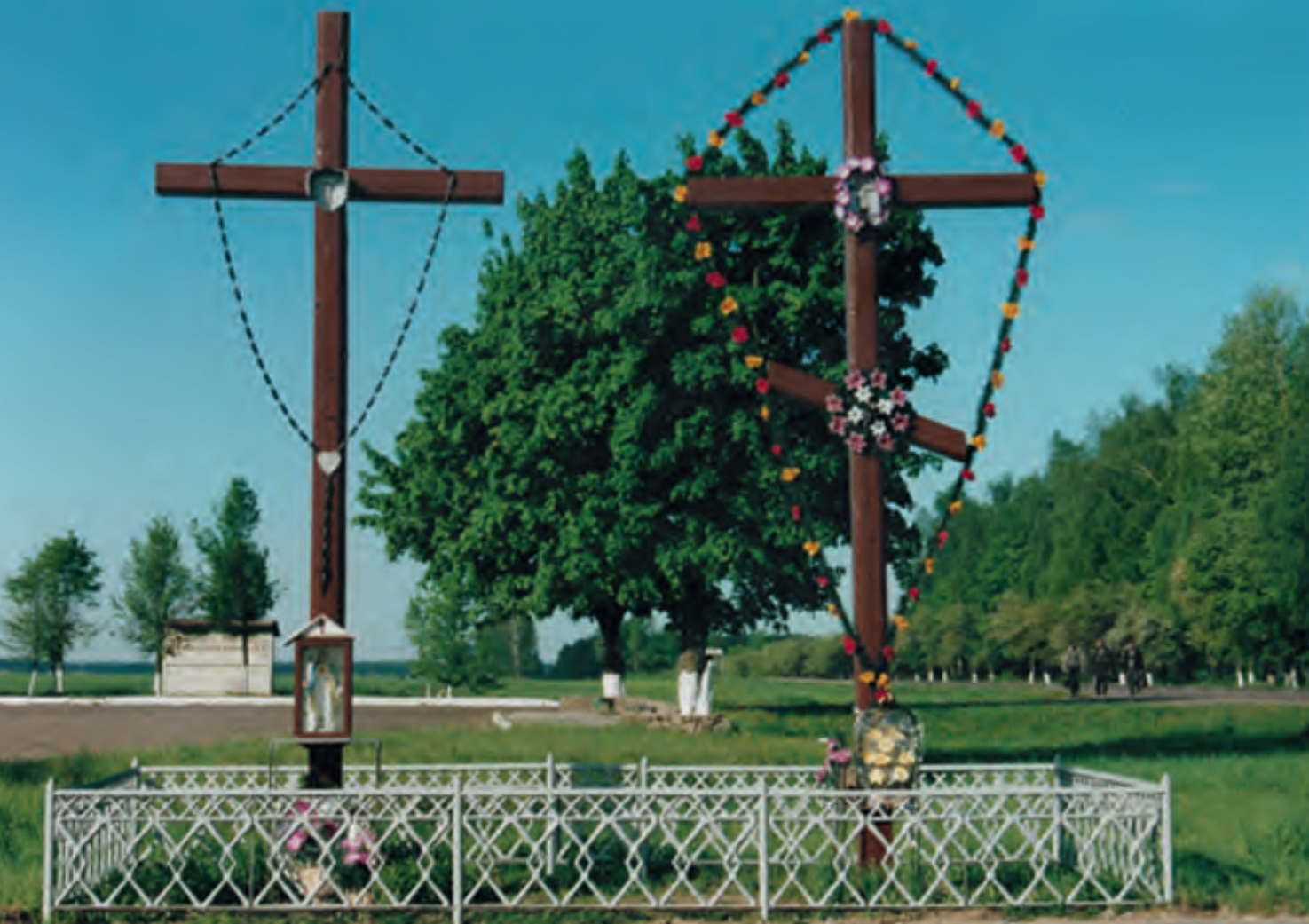
Illustration 1, Justyna Straczuk, “Ecumenical neighborhood of crosses on the village border", The Graveyard and the Table page 233
By Evelyn Bagley, Brandeis University
The Wisła (Vistula) River runs the length of Poland, threading together uplands, lowlands, and cities before emptying into the Baltic Sea. In cultural memory, water often signals freedom: the possibility of circulation, trade, and escape. Rivers promise movement without rupture, continuity without confinement. Yet much of eastern Poland tells a quieter story, shaped not by the promise of flow but by borders that must be lived with rather than crossed.
It is against this backdrop that, in The Graveyard and the Table (2006/2021), Polish social anthropologist Justyna Straczuk—working across Catholic and Orthodox communities on both sides of the Polish–Belarusian border—examines how difference endures in place, through ordinary material forms that make living together possible without requiring resolution. Her monograph offers a way of thinking about coexistence as a form of everyday endurance: how people live with inherited difference without needing to overcome it.
Drawing on long-term ethnographic fieldwork conducted between 1993 and 2003 in villages along the Polish–Belarusian frontier, particularly in the Podlasie and Minsk regions, Straczuk deliberately frames the area as a denominational—rather than national—borderland, where religious affiliation structures everyday social life more durably than citizenship or ethnicity. This distinction is crucial. While state borders and political affiliations have shifted repeatedly in this region, difference between Roman Catholic and Eastern Orthodox communities—two separate Christian traditions, each with its own ecclesiastical authority and ritual practice—has remained a stable axis of social life, lived and adjusted through day-to-day practice rather than settled in official doctrine (11–13).
Working across cemeteries, households, and church holidays in Catholic villages such as Papiernia (Papyernya) and Orthodox villages like Topolany and Potoka in Poland, and mixed settlements including Radziwoniszki in Belarus, Straczuk traces how denominational life is sustained through graves and meals rather than belief statements or formal declarations. Through burial practices and shared meals, religious difference is embedded in everyday social relations, lived and negotiated rather than abstractly declared. Borders persist here less through absolute enforcement than through routine management—read, calibrated, and carried forward through daily material practices. Stone and table take on work that law and ideology cannot. They render difference intelligible without hardening it into conflict.
Straczuk’s decision to frame the region as a denominational borderland instead of an ethnic or national one quietly reorients how belonging is understood. Catholic and Orthodox affiliation does not function here as a fixed identity category, nor does it align neatly with language, citizenship, or ancestry. Instead, denomination operates as a situational sign, activated through liturgical calendars, burial rites, kinship obligations, and material form. By foregrounding denomination, Straczuk captures a scale of social life that resists both nationalist simplification and cosmopolitan abstraction. Read against narratives of freedom rooted in circulation, her borderland shows how difference is sustained less through movement than through the careful management of shared social life in place.
Forms of Coexistence
The Graveyard and the Table can be read as a work of material ethnography—one that treats graves and meals not as symbolic backdrops but as forms that actively organize denominational life. Stone and table function as analytic objects: infrastructures through which difference is made legible, coordinated, and sustained without requiring resolution. Rather than situating Straczuk’s work within a broad comparative frame, it is most productive here to stay close to the internal logic of her ethnography, tracing how repetition, calibration, and silence allow coexistence to endure in place. For many families, these practices are not experienced as “border life” at all, but simply as the ordinary inheritance of place.
Read this way, Straczuk’s monograph offers a model for understanding coexistence as a durable social achievement—maintained through form, timing, and silence rather than reconciliation or hybridity—with relevance far beyond Central and Eastern Europe. In doing so, it also offers a theory of living with difference: how social worlds manage enduring asymmetry without recourse to consensus, assimilation, or resolution.
Two material sites organize this coexistence most visibly: cemeteries and tables. These sites do not eliminate denominational tension or historical grievance. They provide durable forms through which potential conflict is redistributed into space, sequence, and routine.
Cemeteries as Readable Borders
“There are no places here which are supposed to be ‘ecumenical,’” Straczuk writes of the region she studies (57). Burial grounds are institutionally divided, even as everyday practice softens their symbolic force in use. Rather than simply reflecting denominational difference, cemeteries in this borderland actively organize and stabilize difference, rendering it visible, legible, and manageable without producing open conflict. In this sense, they function as readable borders: sites where difference must be arranged, displayed, and calibrated through material practices.
In the Catholic–Orthodox denominational borderland Straczuk explores, cemeteries are among the most densely legible social spaces. At first glance, they appear orderly: aligned rows, familiar crosses, inscriptions facing the same direction. Yet closer attention reveals patterned variation. Difference persists here not as disruption, but as calibration, worked quietly into stone.
Family plots gather the dead across generations, binding kin through proximity. Fences often separate Catholic and Orthodox burial grounds even when they lie side by side, but within these boundaries affiliation is marked more subtly. Names appear in Latin or Cyrillic script, sometimes paired on a single stone. Script choice is never neutral: It indexes ecclesiastical authority, ritual alignment, and historical belonging without requiring explanation.
The arrangements themselves are not symmetrical. Catholic cemeteries in the region are typically parish-based and situated near churches, shared by several villages, while Orthodox cemeteries more often “belong to one village” (58) and may lie at a distance from the settlement itself, sometimes at the forest’s edge. Spatial location thus compounds denominational distinction, shaping how memory is encountered as either communal or locally bounded.
Straczuk describes one shared family plot bearing two differently shaped crosses and two scripts. The iron and stone of the graveyard does not merge traditions or compel a choice between them. Each sign remains intact, legible to those who know how to read it. What might appear, from a distance, as compromise is better understood as calibration: an arrangement that preserves difference but does not resolve it.
Such gravestones presume a form of denominational literacy—an ability to read script, cross form, and placement as social alignment rather than decoration. As Straczuk notes, this “local world of meanings” (30) allows the gravestone’s form to communicate affiliation without explanation. The grave does not announce denominational differences. It waits for recognition. In this way, denominational knowledge circulates without instruction, sustained through familiarity rather than discourse.
Occasionally, this difference is sharpened rather than absorbed. A sequence of Catholic crosses interrupts an otherwise uniform row of double-barred Orthodox ones, marking doctrinal insistence rather than accommodation. These moments stand out precisely because they are uncommon. Most graves participate in a local pragmatism that favors continuity over declaration, rendering difference readable without escalation.
This calibration does not imply equivalence. Catholic villages in the region tend to carry higher symbolic prestige within local hierarchies shaped by state power and church authority, while Orthodox affiliation bears the marks of marginality rooted in longer histories of political and ecclesiastical subordination (36–38, 95–99). These asymmetries are not debated directly. They are absorbed into the spatial and material organization of burial grounds themselves.
Parish-based Catholic cemeteries are typically located near churches and denominationally exclusive, reinforcing their institutional authority through proximity and enclosure. Orthodox burial grounds, by contrast, are more often situated at the edges of settlements—sometimes in forested areas—and are more accommodating of mixed-denominational burials (57–60). Through these arrangements, broader histories of power are folded into the landscape in ways that remain legible but nonconfrontational, allowing difference to persist without being named, ranked, or openly contested.
In this sense, the cemetery performs ongoing work as a readable border for the living. By making religious divergence legible but contained, it sustains a local equilibrium in which denominational life endures without constant rehearsal. Anchored in place, the dead do not resolve denominational differences—but they make living with them possible over time. The graveyard therefore does more than reflect affiliation—it helps define it, functioning as a public index of a village’s religious status in the borderland and a material record of how asymmetry and coexistence have been managed across generations.
Tables as Temporal Borders
If cemeteries stabilize denominational difference in space, tables—sites of everyday meals and memorial commensality—manage it in time. This is true both at home and, for Orthodox family members, at memorial tables in cemetery spaces, where eating and remembrance converge. Meals unfold as sequences rather than enclosures, choreographing proximity through rhythm, timing, and repetition. In the borderland Straczuk describes, commensality renders religious distinction negotiable, moment by moment, through calendars, dishes, and silences—without erasing it.
Households orient themselves around overlapping but nonidentical ritual cycles. Catholic and Orthodox feast and fast calendars rarely align perfectly, producing moments when one household member eats while another abstains, or when a dish is permissible to some and forbidden to others. These moments do not typically erupt into conflict. Instead, they are handled through quiet adjustments: an extra pot set aside, a dish delayed, a substitution made without comment. As Straczuk notes, such adjustments are treated as “obvious” or “self-evident” within households, requiring no explicit negotiation: “The extension of religious functions to other social functions also lends various social norms a certain sanctity, becoming obvious and indisputable” (84). The work of coordination takes place before disagreement surfaces.
Temporal misalignments are not incidental—they are structurally patterned. Catholic liturgical practice consolidates collective remembrance of the dead into All Saints’ and All Souls’ Days, producing a single, intensified moment of communal obligation. Orthodox calendars, by contrast, distribute remembrance across multiple dates, including the third, ninth, and fortieth days after death, as well as several collective memorial Saturdays. As one interlocutor explains, “for forty days the human soul wanders around the house” (77), a belief that gives temporal extension moral weight. The result is not disagreement over remembrance itself, but a persistent asymmetry in when and how obligation is enacted—an asymmetry that households must manage domestically, often at the table.
Straczuk’s attention to meal sequencing is especially revealing. What is served first, what is delayed, and what is omitted altogether become ways of marking denominational boundaries without erecting them explicitly. Meals often unfold at the pace of the most restrictive practice, a choice driven by the preservation of harmony rather than dominance. Much of this coordination is sustained through gendered labor as women—frequently positioned between denominational inheritances through marriage—manage calendars, anticipate moments of friction, and plan meals accordingly. As Straczuk notes, this bilateral structure of kinship renders women “predestined to denominational duality” (213), situating them as temporal mediators whose labor appears as foresight: compromise enacted before it must be discussed.
These rhythms are learned early. Children grow up observing when one relative eats and another waits, when a dish is passed and when it is withheld. Denominational knowledge thus circulates intergenerationally through timing rather than instruction. As one interlocutor reflects, respect across denominational lines is cultivated early, not through formal teaching but through everyday practices of sharing meals and observing one another’s obligations (102). In this sense, the table functions as a site of apprenticeship where children learn to read calendars before they can articulate them, to recognize abstention as ordinary rather than exceptional. The management of difference is absorbed as a habit, folded into the background of domestic life. Here, learning is not framed as tolerance in the abstract. It is practical, embodied, and relational.
Alongside these temporal adjustments, food itself carries denominational signatures. Certain dishes appear reliably at Orthodox tables, others at Catholic ones, even when ingredients overlap. Yet these signatures are portable: Neighbors exchange food across denominational lines, and families attend one another’s holiday meals and services without collapsing affiliation (194–197, 201–203). A dish can be shared without surrendering its symbolic origin, much as a script can be read without being adopted.
Silence, too, plays a crucial role at the table. Questions about why one person eats and another does not are often left unasked. Explanation is deferred not because difference is invisible, but because it is already understood. The table presumes a shared denominational literacy already in place. What matters is not consensus, but coordination. A meal succeeds if no one is forced to violate obligation or justify it aloud.
Unlike the cemetery, which fixes denominational differences materially, the table remains provisional. Each meal dissolves as soon as it ends. Yet it is exactly this impermanence that gives commensality its flexibility. Adjustments can be made daily. Compromises need not be permanent. Difference is handled in installments rather than resolved once and for all.
Sea, Stone, Table
Set against Straczuk’s account in The Graveyard and the Table, Polish cultural imaginaries of freedom—often figured through water—highlight what her borderland does differently. If rivers, ports, and seas suggest circulation, escape, and outward possibility, Straczuk’s monograph reorients freedom toward endurance. Here, social life is organized not around leaving, but around staying—with kin, with neighbors, and with inherited forms of difference that cannot be transcended through motion alone.
Stone and table anchor this alternative orientation. Cemeteries bind denominational affiliation to place, fixing memory in material form and carrying religious differences forward across generations. Tables, by contrast, manage denominational difference in time, allowing misalignment to be absorbed through sequencing, delay, and silence. Together, these sites reveal a mode of coexistence sustained not through synthesis or reconciliation, but through repetition with variation. Difference is sustained through calibration, held between erasure and dramatization.
What emerges is not simply a description of Catholic-Orthodox relations, but a social grammar in which borders are lived as conditions rather than crossed as thresholds. Scripts remain legible, side by side. Calendars misalign without forcing rupture. Silence does as much work as speech. Denominational boundaries persist not as barriers to be overcome, but as forms to be read and inhabited. Coexistence, in this account, is not a moral achievement or a political settlement. It is an ongoing practical accomplishment.
At the same time, the grammars Straczuk describes depend on the continued co-presence of people, places, and material forms. Cemeteries and tables work because they are embedded in dense local worlds where memory, obligation, and recognition overlap. When these conditions shift—through occupation, displacement, urbanization, secularization, or diasporic movement—the infrastructures that calibrate difference must be remade. Stone may become inaccessible; tables may gather people whose calendars no longer align through shared history but through deliberate reconstruction. In such contexts, the work of managing differences becomes more explicit and more fragile.
At a moment when difference is increasingly framed as a problem to be solved—politically, morally, or administratively—Straczuk’s borderland offers a reminder that coexistence often depends less on agreement than on durable forms that make living-with possible. Read beyond its immediate ethnographic setting, The Graveyard and the Table provides a framework for understanding how social worlds manage enduring difference in contexts ranging from religiously plural neighborhoods to diasporic households and post-imperial border regions, where asymmetry cannot be resolved through consensus or mobility alone.
By shifting attention from crossing borders to staying in place, Straczuk offers a corrective to border studies approaches that privilege transgression, hybridity, or flow as the primary sites of analysis. Her ethnography shows instead how borders endure through ordinary infrastructures—stone and table—that stabilize difference without naming it and manage asymmetry without adjudicating it. In doing so, she provides a vocabulary for understanding borders not as lines to be crossed, but as forms to be read, paced, and shared over time: a condition of social life quietly carried forward, not despite difference, but through it.
Works Cited
Straczuk, Justyna. The Graveyard and the Table: The Catholic–Orthodox Borderland in Poland and Belarus. Peter Lang, 2021. https://doi.org/10.3726/b19019
Edited by Aida Kasparova (Columbia College '29) and Canyon Sallady (Columbia College '29)