
Children in War Films as a Vessel for the Feelings of the Collective
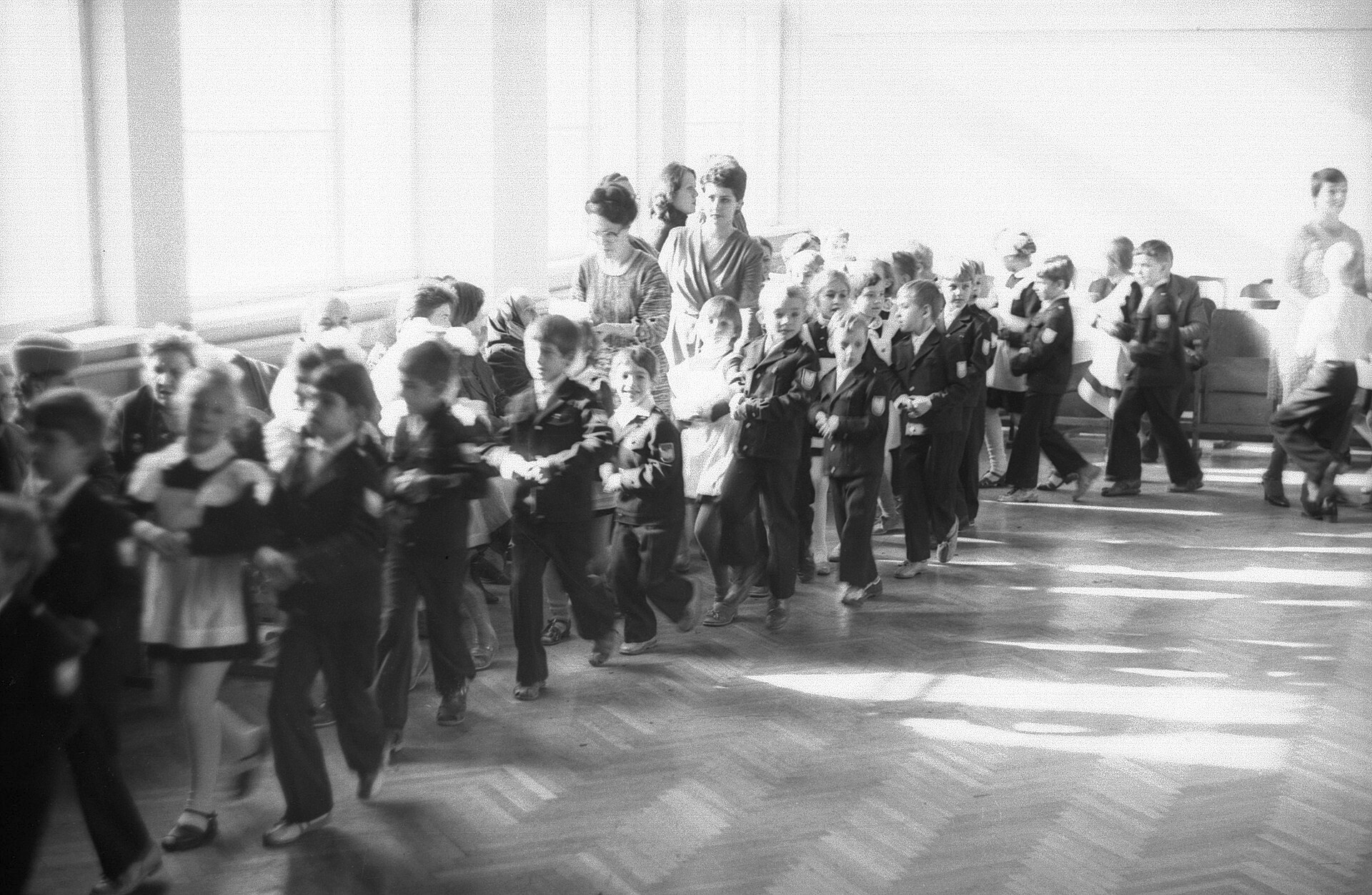
Soviet schoolchildren, Rostov-on-Don, Wikimedia Commons, 1984.
By Eamon Maloney, Georgetown University
“In these tragic times it’s hard to be an adult being,
in fact it’s hard to be a human being.”
House with a Turret (2012)
In war cinema, children occupy a unique position as emotional conduits, articulating feelings that adults have learned to suppress or cannot express. While adults typically fulfill roles demanding responsibility, such as soldiers, leaders, and nurses, who are bound by duty to their country or collective, children do not have such obligations and are free to speak and act without the weight of societal expectations. Unburdened by the histories adults carry into conflict and unschooled in the emotional facades that function as coping mechanisms, children become vessels shaped by war itself. In the war films In the Rearview and House with a Turret, directors highlight the underlying human emotion and collective trauma affecting their respective societies through a focus on children and how they navigate their experiences.
Emotional Articulation in a Mobile Confessional
The contrast between child and adult emotional expression in wartime becomes especially evident in a unique documentary setting, where their unfiltered reactions stand out against the perceived stoicism of those around them. After the start of the full-scale Russian invasion of Ukraine, Polish director Maciek Hamela became an aid worker, driving evacuees from Eastern Ukraine to safety in the West. After several journeys, Hamela decided to set up a camera in his van and began documenting refugees’ stories, doubling as a mobile rescue and confessional booth across war-torn Ukraine. Hamela’s 2023 documentary, In the Rearview, compiles these conversations into an elaborate portrait of refugees, focusing on their individual lives and stories. The interviews cover a wide range of topics; people discuss what they had to leave behind, the actions of Russian soldiers, their origins, and their destinations. What begins to stand out is that their talks remain general, rather than personal and emotional. Many bear this unthinkable reality with the same stoic face. They gaze out the windows at the ravaged landscape; some discuss the logistics of relocation or recount events, but they rarely pause to acknowledge the grief or fear beneath their words. However, in the films, it is clear that there is a population not yet numbed to the reality of war: children.
While the adults in Hamela’s documentary offer a detailed picture of the varied experiences and horrors of the war through their stories, the scenes with children strike a more emotional and humanistic tone. The adults contextualize their experiences through frameworks, comparing the current crisis to past hardships, or focusing on practical concerns like destination and shelter. But children lack these psychological buffers, and without decades of accumulated experience to relativize their suffering, they exist purely in the present horror. Yet this vulnerability allows them to access and express emotions that adults have learned to compartmentalize.
Though the children do often talk about their physical experiences, there are also several scenes where they cannot contain the horrors in the same way. They express feelings of longing, fear, and love. It is not that the adults do not miss their homes or don’t fear bombs, but they have other responsibilities that restrict them from voicing these feelings. It is the children who are unburdened by responsibility who have the time to reflect and express in the comfort of Hamela’s van. In one touching scene, the camera focuses fully on a young boy, who has just learned from another child that the definition for ‘worried’ is “when Grandma thinks a bomb will hit your house.” The boy sits in silence for about thirty seconds before exclaiming, “I love Grandma.” He says this unprompted, almost as if he cannot hold that thought in. It is something very deep, emotional. We can assume that the mother of this child also misses the grandmother, and that everyone who passes through Hamela’s van has someone they miss. He chooses to highlight how the children express themselves emotionally, while giving the adults room to discuss their more material experiences. By allowing the children to become the underlying emotional voices of the war, Hamela can combine these two perspectives and paint a much clearer, and in many senses, more real picture of the conflict.
Post-War Trauma in Fiction
This emotional potency isn't limited to the documentation of contemporary conflicts; historical war narratives reveal similar patterns of children bearing emotional weight. The landscape of post-WW2 Russia in Eva Neymann’s House with a Turret (2012) follows an unnamed eight-year-old, known as ‘Little Man,’ travelling with his mother. Having spent his formative years immersed in warfare, the boy remains quiet and illiterate, though remarkably determined. When his mother falls ill during their journey, she is taken away. The boy tries to find her, encountering a world where everyone bears the stoic marks of war. After his mother’s death, Little Man is forced to become his own parent. He wanders the silent landscape, mostly ignored by everyone he encounters, unless he strongly persists. Many adults are too occupied by their own survival to protect him. Eventually, one family realizes they can use him for their own gains, and he is taken with them.
With this new family, Little Man finds himself trapped with them on a train of refugees. It is intimate and claustrophobic, hosting a diverse crowd of children, families, and veterans. However, unlike In the Rearview, where displaced people trade war stories or laugh and cry together, the refugees of the House with a Turret try to talk about anything else. They distract themselves from the destruction of war by exaggerating more minor problems, fighting between themselves over petty things, and, especially within Little Man’s adoptive family, lying. The train is also an escape from whatever part of the war they have fled. They are now back in relative safety, traveling towards a new future and leaving the past behind.
On the train, Little Man remains mostly silent, reflecting on his loss, which he does not open up about with anyone else. In one striking scene, while waiting in line for the train’s bathroom, a passenger asks Little Man where his mom is. He lies, saying she is fighting for the partisans, but is quickly corrected by his adoptive mother, who calls him a liar, after which he runs off back to bed. Little Man’s imitation of lying is an attempt to assimilate into the collective and express himself the same way that they do. Little Man also wishes to put the past behind him, building a more heroic background for himself. When he is called out and fails, he is forced to confront the truth of his mother's death. His subsequent retreat to bed, a natural withdrawal for a child, contrasts with adult strategies of loud conversation and distraction. Once again, it is certain that everyone on the train has lost someone and something. The safety of the train, the thoughts towards the future, and the opportunities and responsibilities it holds, as well as the banter between comrades, allow a brief reprieve from these horrors. Because Little Man is explicitly excluded from this safety, he is expressing a more raw, unfiltered emotion. Little Man remains silent because he has no one to express himself to, but this silence is striking against the boisterous nature of everyone else.
Only one other character has a sober look at the reality of loss, a drunk veteran, who is one of the few characters who actively tries to help Little Man. The soldier has likely lost just as much, if not more, than the boy and is equally unprepared to return to normal life as if nothing had happened. This pairing is crucial; the veteran's alcoholism acknowledges his trauma through destructive coping, while Little Man's silence represents the same acknowledgment through childhood vulnerability. They are different developmental stages of the same wound. The veteran, forced to reintegrate and using alcohol to cope, recognizes in Little Man a kindred spirit. They are both characters for whom the collective's forward momentum feels like erasure rather than healing. After World War II, Russia quickly began to rebuild and rearm itself for the coming Cold War, moving forward from the tragedy at blazing speed. Yet millions had lost everything they held dear, and no amount of propaganda could heal that. Behind the patriotic feelings of victory and the mask of Soviet power, people were lost, unable to process their grief while struggling to survive. Little Man is not allowed to participate in this illusion, however, and instead feels the full reality of the war, becoming a symbol for the underlying trauma pervading the country.
Generations Defined by and Defining War
The representation of children in these war narratives creates an emotional framework through which audiences can process the broader psychological impact of conflict. While adults in both films have developed complex mechanisms to navigate trauma, like stoicism, deflection, or silence, children like Hamela's young boy, expressing love for his grandmother, or Neymann's determined "Little Man," become the authentic emotional core of their communities. Their lack of the typical adult emotional restraint allows them to articulate feelings that remain buried beneath layers of survival instinct, cultural expectation, and responsibility. Children in war films become unwitting vessels for psychological trauma that is undoubtedly felt by the collective. Directors can highlight these figures and their stories, revealing that beneath the stoicism and resilience of wartime survivors lies a profound grief and emotion that is most easily expressed through war’s youngest victims.
Edited by Virginia Heretick (Columbia College '28), Effie Gao (Columbia College '28), & Lora Tseytlin (Barnard College '27)