
Heritage Throughlines in Geopolitical Conflict: Urban Identity and Immigrant Placemaking in Little Ukraine, NYC
By Ishaan Barrett, Columbia College, Columbia University
“To talk about that world, about Ukraine and Ukrainians in New York, you first have to make a few decisions about what Ukraine is” writes Christopher Bonanos for New York Magazine. “In the past few centuries, Ukraine has been chopped up a half-dozen different ways. The city of Lviv has been called Lwów (when it was Polish) and Lemberg (when it was in the Austro-Hun garian Empire). Other parts of the country have been run by Germany, the Soviet Union, Romania, the Ottoman Empire, and (twice) an independent Ukrainian government. That jumble is reflected in the assemblage that is Ukrainian America.” These words provide a compelling introduction to Bonanos’s detailed history to one of the most overlooked immigrant enclaves in New York City. From the First World War and arrival of new immigrants in the region to the growth of new wave music and Russia’s invasion of Ukraine, Bonanos’ account is vast and demonstrates the rich urban history endemic to Little Ukraine. Other scholars like Bonanos have explored similar representations of fragmentation and identity pluralism in Little Ukraine. For instance, Devon Ivie and Camille Sweeny document the development of new musical genres and performance styles characterized by Rock bands and punk groups who cohered eastern and western musical styles and traditions. Similarly, researcher-ethnographer Anna Fín turns to the artistic and immigrant worlds of the Little Ukraine neighborhood in her work. She demonstrates how the intersection of “alternative artistic and intellectual culture” can positively transform urban enclaves while elevating the status of these enclaves and their cultures among the diaspora. Against this corpus of interdisciplinary background scholarship, Petra Bartosiewicz and her colleagues document the oral histories from local residents and documents from four crucial nearby landmarks to track and diligently analyze changes to Little Ukraine over many decades.
The summary of existing scholarship above highlights the profound changes within Little Ukraine while drawing attention to the neighborhood as a critical site to study immigration, Eastern European heritage histories, and urban placemaking. Yet a contemporary understanding of Little Ukraine – one that puts current politics in conversation with the neighborhood’s historic legacy is largely excluded from this record of previous scholarship. Political changes in the first one hundred days of the Trump administration have radically shifted the balance of global politics in Eastern Europe. The White House’s more aggressive anti-immigration politics have sent shockwaves through American urban centers, like NYC. Rising apathy toward Ukraine within America’s new government specifically exacerbates this predicament for urban ethnic enclaves from the country and its neighboring region who find themselves increasingly cast aside. Consequently, the central task of this article—and the larger work of this research overall—seeks to understand how residents of Little Ukraine grapple with identities under increasing threat by analyzing how this unique urban enclave reflects and refracts the global political struggles beyond it. It asks: first, how is global conflict and identity struggle mapped onto urban space and how can techniques in visual ethnography, as a research and archival process, preserve the sanctity of immigrant enclaves; and secondly, how can these efforts relay attempts to resist the erasure of immigrant cultures and expose new ways of living and celebrating ethno-social cohesion?
To bring these questions to life and at ground level in NYC, several critical methodological frameworks are pieced together. This work engages with urban sociologist Henri Lefebvre’s concept of the social production of space to contextualize Little Ukraine’s urban environment. In accordance with this theory, Little Ukraine and its urban backdrop are studied as an environment informed by human behavior, lived experience, and representations of the self. This social concept, a cornerstone of urban affairs research, is foundational to analyzing the relationship between people and their built environment. To complement this theoretical approach, anthropologist and social theorist Sarah Pink’s framework for urban ethnography aids in providing a tool to observe this social production of space at work. Pink argues that photography and visual discourse analysis are critical tools that can document and interpret urban social behaviors and identities in situ, or “in place” within the city. This offers a significant advantage for this project, where Little Ukraine’s changing demography, urban landscape, and core identity as an immigrant enclave exist in response to the United States’ foreign policy changes and rising xenophobia around the nation. The visual signs of this relationship within the neighborhood are visible at surface level, where flags, symbolism, and architecture translate the cultural history and inherent legacy of change in Little Ukraine through a visual component. Thus, the practice of visual ethnography alongside Lefebvre’s theory are systematically—and advantageously—combined in this study to critically examine the culture, identities, politics, and practices of Little Ukraine’s urban spaces.
In essence, this project relies on Lefebvre’s ideas about how humans relate with the built environment and the act of visual analysis to understand how a neighborhood and its ethno-social history make sense of a global conflict and its relationship to the American political atmosphere of the present. The historical context and background necessary to understand Little Ukraine was gathered from the photographic archives of the Ukrainian Museum. The collections of the Museum are vast, but this project focuses on historical photography relating to the Ukrainian community in NYC over the past fifty years.
Results: The Disappearance of Little Ukraine
Through ten weeks of in-person visits to Little Ukraine (including two weeks of scouting and street photography) and a weekend spent visiting the archives at the Ukrainian Museum, my work has surfaced important answers to how we understand identity, immigration, and urban placemaking over time.
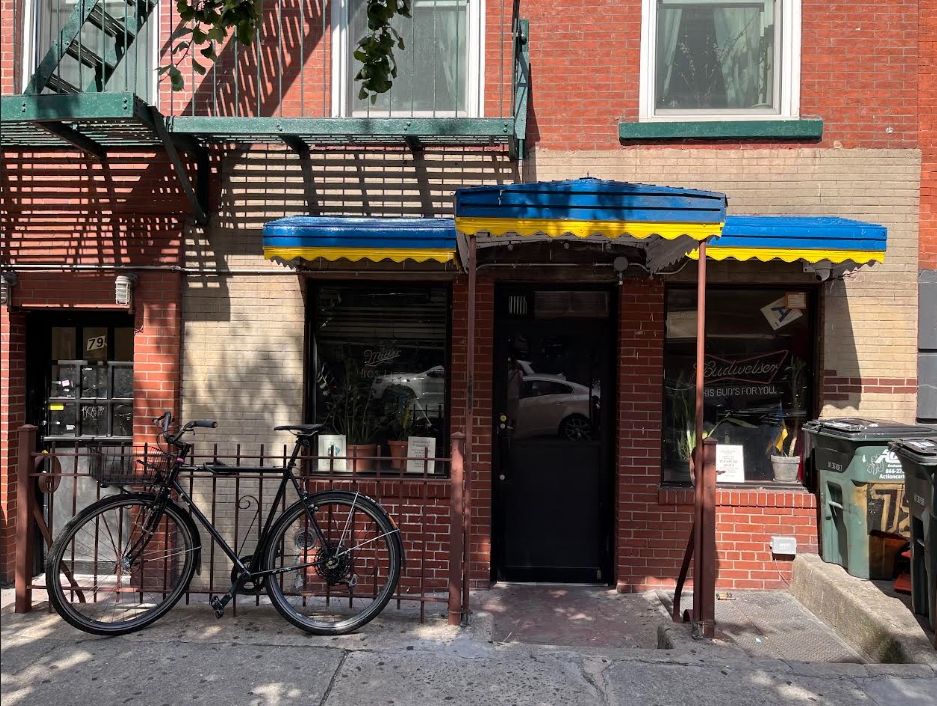
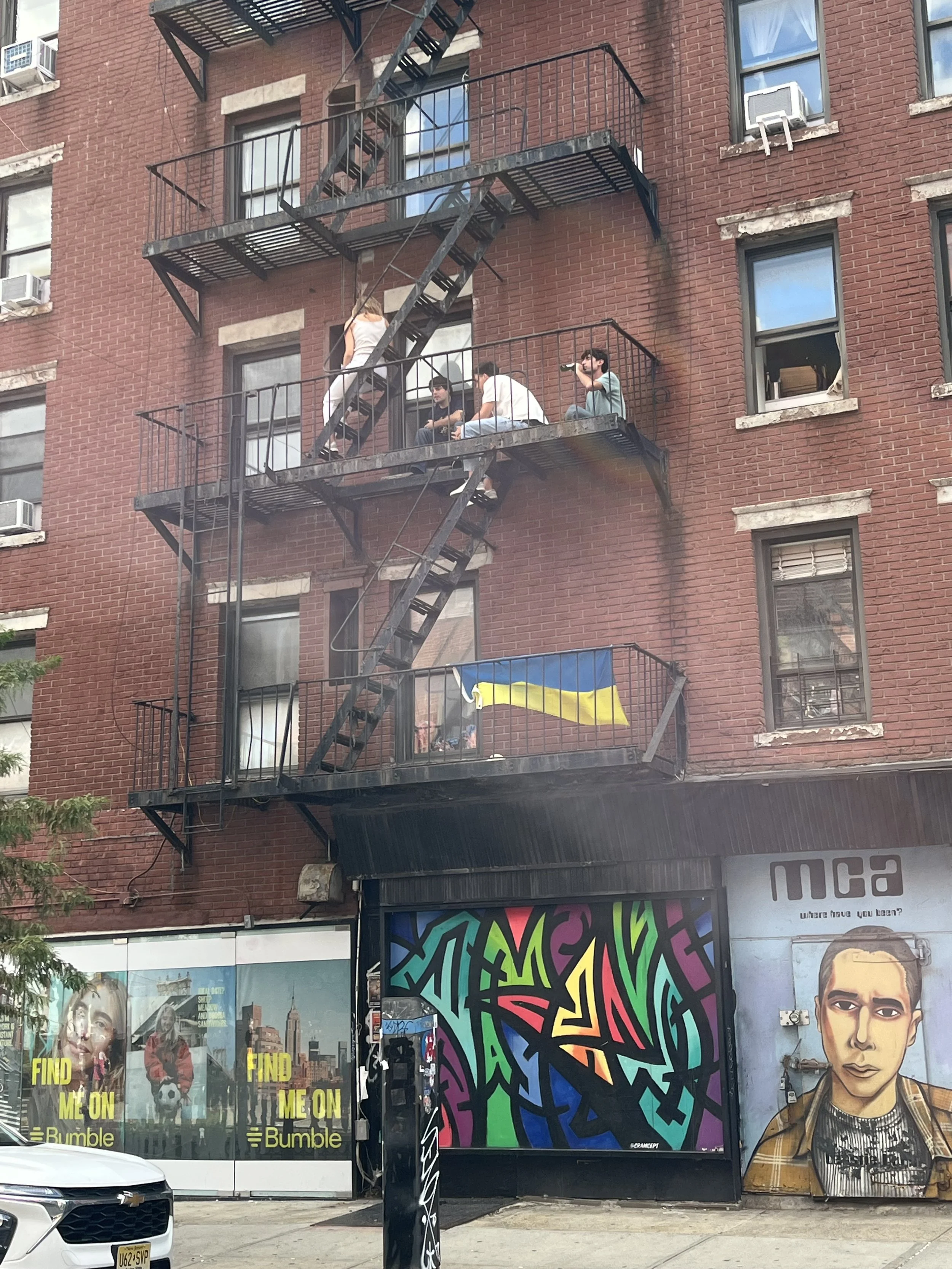
On the ground visual ethnography and analysis of NYC’s Little Ukraine shows how identity struggle is mapped onto urban space through iconography, co-opting street-level sightlines, and public art. Flags in windows, painted flower boxes, decorated recycling bins, the historical remnants of old signs, and sunflowers (both real and artificial) speak to a rich history of pro-Ukrainian politics and heritage. These symbols keep the ongoing struggles of war at the front of public attention: when walking through and perceiving the multitude of different spaces, restaurants, parks, and boulevards in the neighborhood these symbols can be easy to spot. Yet, these symbols of Ukraine are hard to notice if you are not looking for them. My work in the archives reveal a much longer history of Ukrainian culture that took place throughout NYC, from loyalty parades and speeches to cultural fairs and protests around the city, in its streets, and alongside past mayors. The visual symbolism of Ukraine and the pro-Ukrainian sentiments engendered within can be read as both an active, ad-hoc expression of resilience considering global conflict and identity struggle, and a symptom of a changing neighborhood. These overt culturally specific practices that are documented in the Ukrainian Museum’s archives give us a clear historical record of Ukrainian culture identity that is rich and public facing.
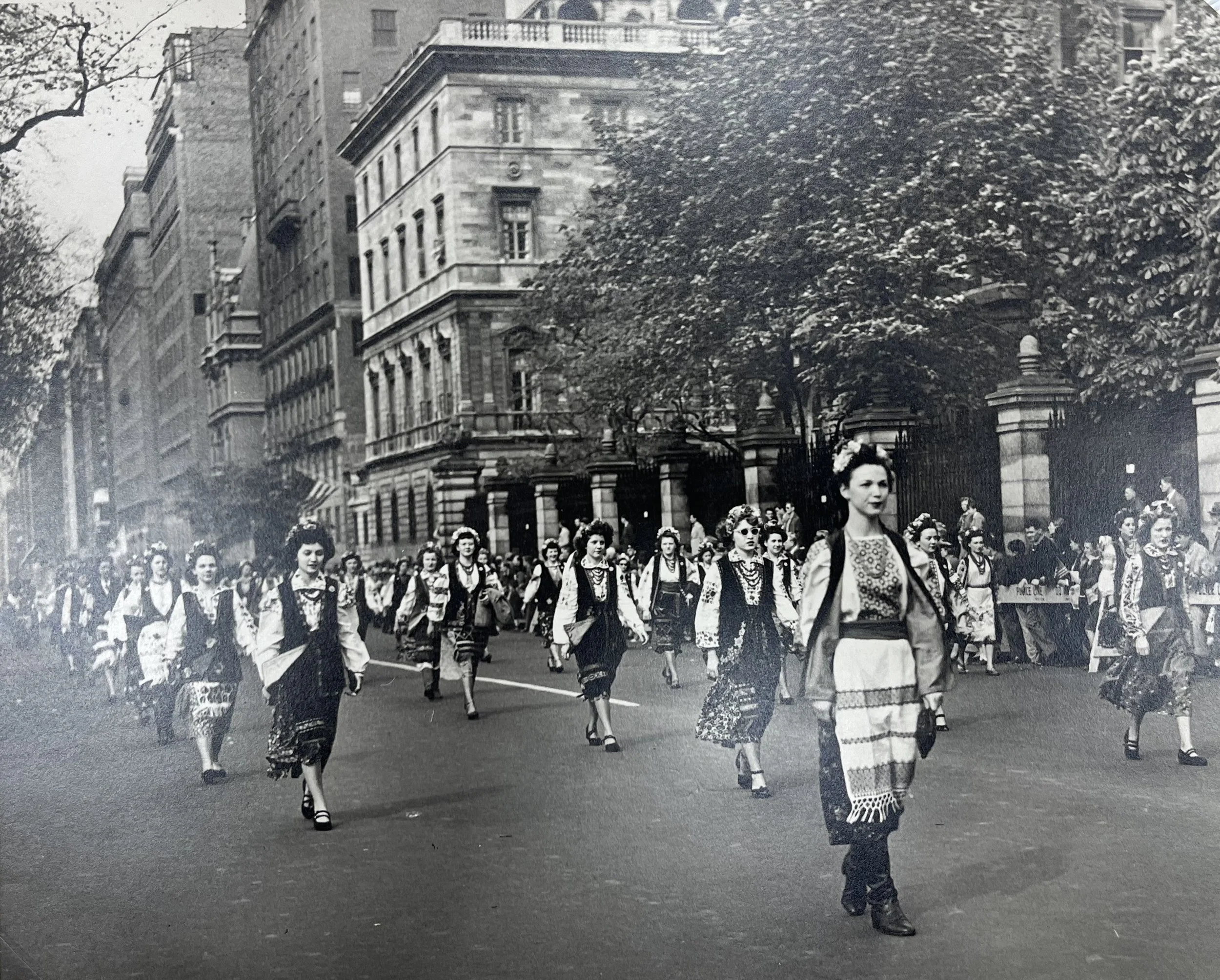
Photo depicting the American Loyalty Parade in New York, 1949. Image courtesy of the Ukrainian Museum Archives and Maria Rewakowicz.
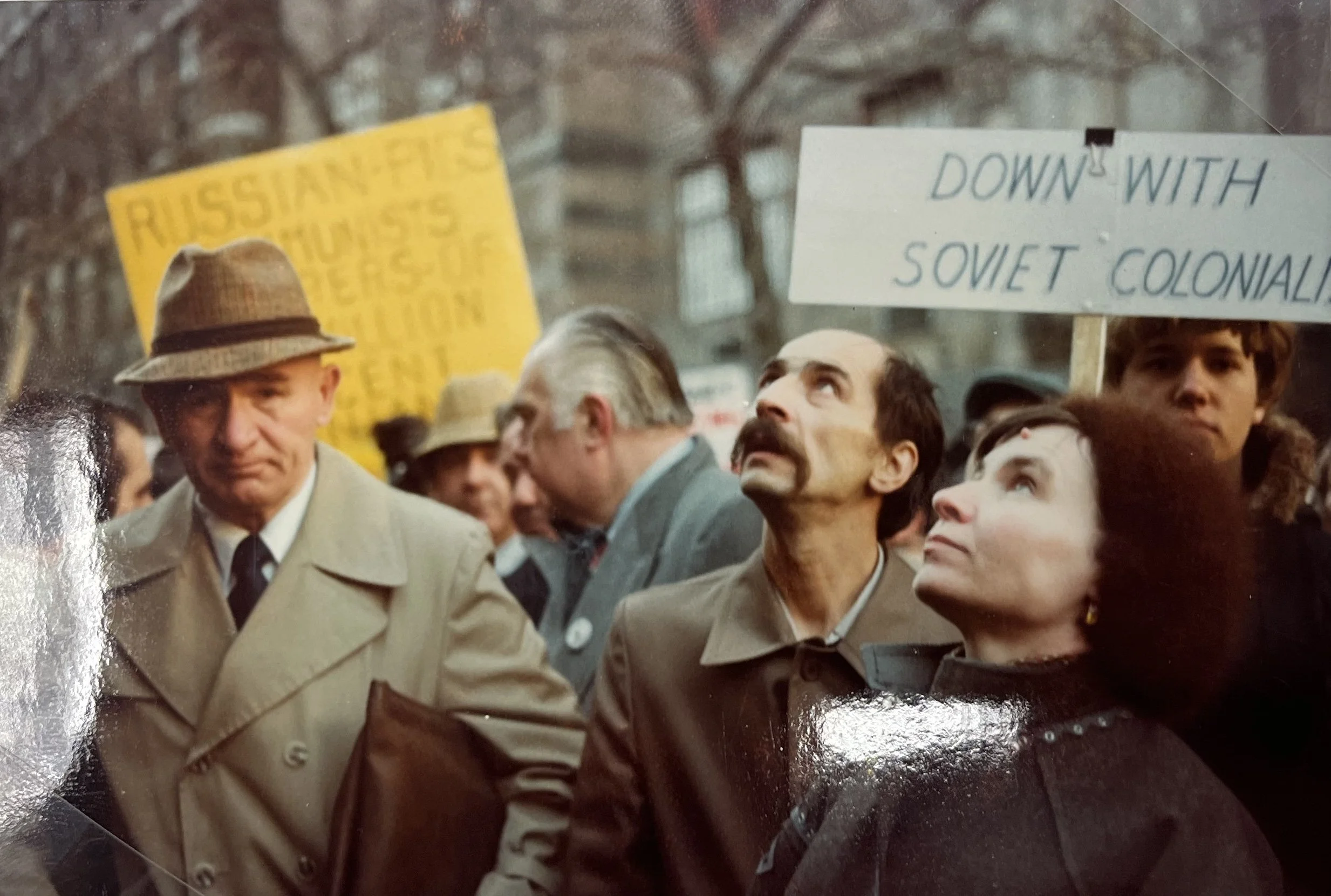
Ukrainian exiled dissidents Gen. Petro Grigorenko, Leonid Pliushch, and Nadia Svitlycha [in November 1978], in front of the Soviet Mission to the United States, New York. Image courtesy of the Ukrainian Museum Archives and Maria Rewakowicz.
The visual symbolism of today, and how it differs from the public programming documented in the archives (fairs, parades, protests, etc.), shows how the identity struggle and resilience that the neighborhood stands for is changing with the rising tide of urban development in the area. Young professionals, students, and new residents of the city are not necessarily erasing the Ukrainian heritage from the East Village but are living more within the neighborhood’s identity as part of the “East Village” as opposed to “Little Ukraine.” The flags, sunflowers, public art, and other iconography of political resilience are subordinated to the fast-paced, academic-professional culture of the neighborhood that differs quite profoundly from the active historical record the Ukrainian Museum offers about the neighborhood and wider NYC from the 1970s onwards. In short, the Ukrainian Museum offers a rich historical record of pro-Ukrainian cultural presence that differs from the subtle symbolism that flags and public art provide; I offer that this more passive form of identity cohesion is motivated by the tides of urban change and a new urban atmosphere written on top of Little Ukraine. Despite its history and position within a didactic heritage of Ukrainian identity, the neighborhood’s East Village identity is now embedded more strongly than its role as an immigrant enclave. Even despite rising political developments which threaten the neighborhood, pro-Ukrainian sentiments remain. And while those sentiments may be subdued, they are just as salient when you find them.
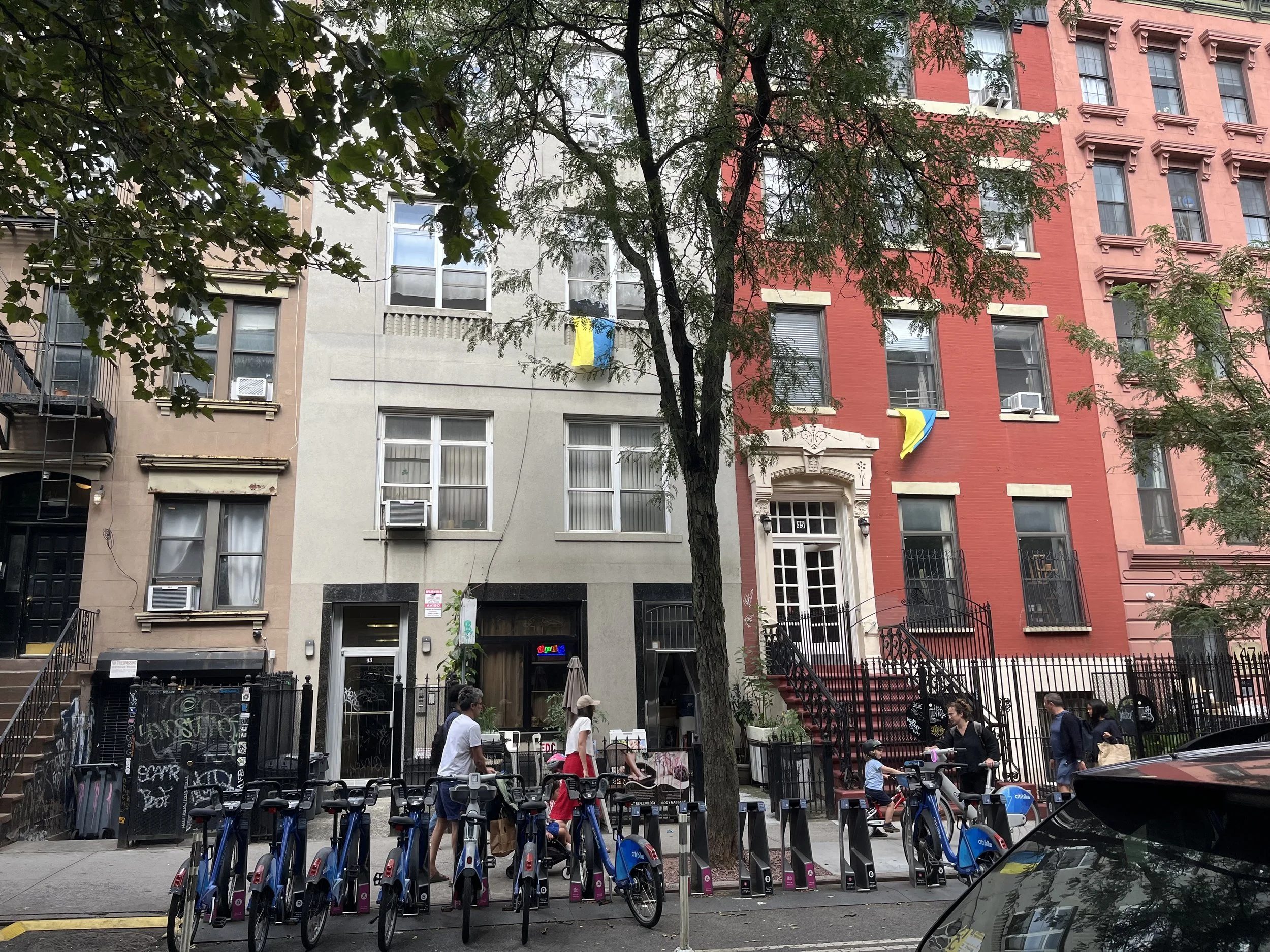
My visual ethnography shows that resistance to this erasure is happening more subtly, and taking place in the form of visual iconography rather than systematic public programming. It shows us that while the neighborhood of Little Ukraine is changing its unique ways of living and celebrating identity, ethno-social cohesion is still present. This happens through the transformation of street-level sightlines and public areas, where walking on the sidewalk makes visible flags and sunflowers that show pro-Ukrainian support, and painted art reminds us of a war happening an ocean away. In other words, I offer that it might not necessarily be a bad thing that systematic public programming—organized parades, gatherings, and city-approved events—is diminishing.
The protests and public gatherings shown in the Ukrainian Museum’s archives are compelling. But the subtle signs that persistently remind us of an issue we should care about and a culture that has a rich history in the East Village are ever-present. Perhaps because I was looking for them, I never once missed or forgot to notice a Ukrainian flag or symbol in all my visits to Little Ukraine (even when walking idly by). People are doing what they can to resist public ignorance to the pressing humanitarian crisis happening in Europe. Immigrant identities are evident across physical and visual spaces, even if they exist more in the background than what historical precedent shows.
The Geopolitical Question
The bulk of the results examines evidence sourced from fieldwork: the photographic and visual evidence showing the quiet expressions of identity and heritage beneath the hectic landscape of the East Village. Yet the political valence of the visual subject matter cannot be ignored. The geopolitical throughlines and the response to these throughlines within the US play an inherent role in how the results of this project grapple with the question of urban development. It might be easy to decide that the salience of pro-Ukrainian heritage and identity is disappearing because the neighborhood is slouching more towards a young, pre-professional and academic undertone, and this argument about urban change overwriting a local history of Eastern European heritage might be correct. But it does not dismiss the larger shifts in American politics that enable political identities—those of immigrants and refugees specifically—to fall to the wayside in historic NYC neighborhoods like Little Ukraine. This section devotes a little time to this question of politics to try and offer an original theory about how shifting public attention and the politics of a hostile White House have allowed the gradual vanishing of urban heritage to occur.
At the end of February of 2024, US President Donald Trump and Ukrainian President Volodymyr Zelenskyy engaged in a fiery exchange surrounding the ongoing war in Ukraine. The exchange not only signaled a perplexing hostility between Trump and Zelenskyy but opened questions into the strength of US support for Ukraine during the ongoing conflict. Of course, it is no secret that the current president has cozied up to world leaders formerly widely classified as dictators. The close association between Putin and Trump which began in his first term is just one indication of this behavioral pattern from the president. Yet, the hostility demonstrated between the two world leaders last February arrived as the conflict in Ukraine officially entered its fourth year. Whether the exchange has more to do with Trump’s changing alignment or to a deeper impatience towards resolving the conflict is uncertain. But putting theory aside, the effect it has had on the public and wider political interests beyond the White House is substantial. Normalizing such hostility towards a US ally and allowing it to be captured on national news undermines the ability for the public to delegate their support to Ukraine in an unbiased way. Trump’s unbridled acrimony allows the type of support that the US has expressed previously, both officially in congress and by communities around the nation, to be scrutinized more easily and even abandoned if people decide to adopt the president’s point of view on the conflict.
It is hard to place blame for the diminishing visual evidence of immigrant heritage and waning political support in Little Ukraine solely on the attitude shifts in the White House. But on the other hand, refusing to acknowledge the effect that administrative agendas have on the salience of political support would give too much credence to the impact a changing neighborhood can have on the development of heritage identities in urban spaces. Coupled perhaps by the sheer duration and gravity of the conflict in Ukraine, these two forces of national politics and local change may contribute to the results that my fieldwork generated. That said, the more challenging question of reversing this process—the disappearance of prominent heritage identities and political support in Little Ukraine—becomes all the more important.
Conclusion
The quiet work of reminding the public of the war in Ukraine is still ongoing. The signs of political resilience are there, patterned across the East Village/Little Ukraine if you know where to look. The work falls to the background of a neighborhood that moves quickly with the energy of academic and professional life. My ongoing work is to complete the photographic archive that I began and make more sense of the images that I gathered in relation to the archival material I sourced at the Ukrainian Museum. For now, my work speaks to a complex relationship between history, a changing city, and the messy geopolitical world beyond, showing that resilience within Little Ukraine is subtle and at times disappearing, but happening nonetheless. One must look carefully for the signs, inspecting closely to bear witness and capture moments of fleeting resilience as it is still unfolding in order to make it permanent.
Acknowledgements
This project was funded through a Summer Fellowship at the Harriman Institute for Russian, Eurasian, and Eastern European Studies. I am deeply grateful for the help of the Head of Collections at the Ukrainian Museum, Maria Rewakowicz, without whom this work would not have been possible. I am indebted to her help, patience, and kindness as I navigated my research questions, and put together this article with a wide array of considerations, findings, and results. I am, of course, grateful to the staff of the Harriman Institute, the fellowship selection committee, Katrina Papouskaya, and Rebecca Dalton for their time and support throughout my work.
Edited by Serena Reed (Columbia University School of General Studies ‘28) and Jay Jacobson (Columbia University School of General Studies ‘28)