
“Out of the Fire”: Translating Belarusian Lexis in the Voices of War Eyewitnesses
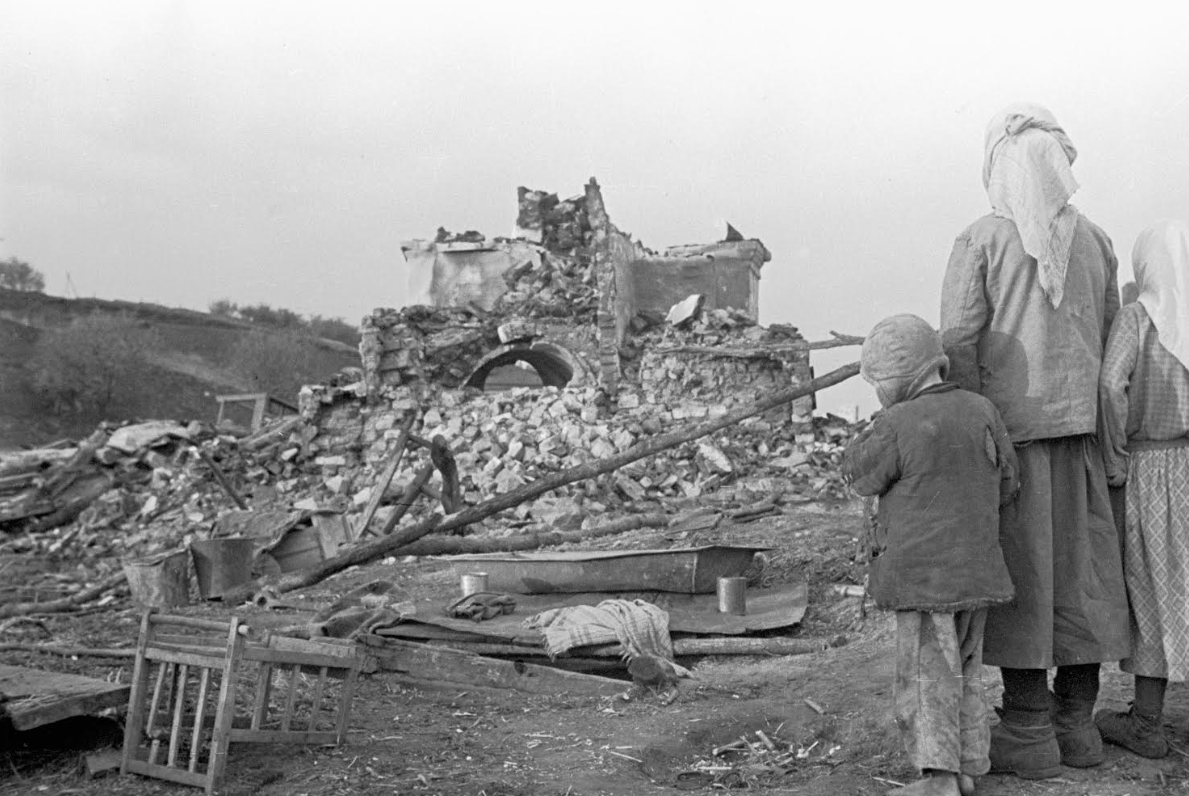
Residents of a Belarusian village stand on the ashes of their home, 1944. S. V. Alperin, Wikimedia Commons
By Lizaveta Tsitarenka, Francisk Skorina Gomel State University, Belarus
The post-1950s period in Belarus saw an influx of literature grappling with the aftermath of the Great Patriotic War. Authors sought not only to capture their own experiences and emotions but also to comprehend the war, the Belarusian tragedy, and the nature of the evil that the people had confronted. To this end, Belarusian writers employed not only fiction but also documentary literature. Although the documentary genre had been explored in Belarusian literature before the Great Patriotic War, such works were still essentially fictional. They did not aspire to complete documentation of context and reality; rather, the narrative itself was prioritised, and factual inaccuracies were not uncommon. This was partly due to the prevailing ideological expectations of Soviet-era literature, which often demanded that artistic representations of war serve the broader goals of patriotic education and heroism, sometimes at the expense of unvarnished historical accuracy. After the war, however, alongside heroic prose, some authors began to approach the tragic experience differently, giving rise to a tradition of documentary prose that would later address the most poignant chapters of Belarusian history—from the Chernobyl disaster to the role of women during the 1941-1945 war. This period is significant, as it saw the publication of a number of landmark documentary works that laid a solid foundation for subsequent Belarusian documentary prose. One such work is “Ia z vohnennai vioski” (Belarusian: «Я з вогненнай вёскі…», meaning “Out of the Fire.”), written by Ales Adamovich, Yanka Bryl, and Uladzimir Kalesnik. This article discusses one significant characteristic of the work: it is a textual transcription of tape-recorded interviews with people who had survived the burning of their villages by the Nazis.
To analyse the value of this work within the context of the development of Belarusian literature, it is important to outline common characteristics of canonical Belarusian war literature and the place of the documentary novel Out of the Fire within it. First, these works were typically written by professional authors who had personal combat experience. Second, for a long time, the narrative focused on the hero, documenting his feats and glorifying his courage. Out of the Fire demonstrated that the central figure of a war narrative can be not only a hero but also an ordinary person—an eyewitness to events. This time, the authors do not glorify courage or enumerate heroic deeds; instead, they show readers the war through the eyes of ordinary people: their experiences, emotions, and understanding of the tragedy. The book compiles testimonies of individuals who personally endured the trauma of the destruction of their villages, the murder of relatives and fellow villagers. The authors visited 147 villages across 35 districts of Belarus to record, on tape, the memories of over three hundred direct participants in the events.
The authors articulated the main purpose of their work in the preface to the book: “to preserve, to hold, like ‘plasma,’ the unbearable temperature of human pain, bewilderment, and anger—those emotions that reside not only in words but also in the voice, in the eyes, in the face—to hold everything that, like air, surrounds the person who spoke to us and now, from the pages of the book, addresses the reader—addresses you” (Adamovich, Bryl and Kalesnik, Out 19). In the same preface, Ales Adamovich writes: “When we were making the book about Khatyn [villages], friends wondered: all of this is necessary and important, but what is a writer’s role here? You come, you arrive, you turn on the microphone, you record… But what does a writer, an artist, have to do with this?” (Adamovich, Bryl and Kalesnik, Out 12). In grappling with this question, the authors of the book, particularly Ales Adamovich, regarded it as their duty as writers to preserve popular and collective memory. According to Adamovich, this is no easy task, and a novice writer would be unable to carry it out because such an author has not yet undergone their own path of creative development: a beginning writer wishes to achieve self-realization, to demonstrate their own unique vision, acquired skills, and authorial style. In this case, as the authors themselves noted, what is required is humility and the ability to serve as a conduit between the memories of the eyewitness and the potential reader. Professional writers, by contrast, are capable of listening to witnesses, guiding them, and rendering their recollections in an appropriate form and genre without directly expressing their own point of view and without the desire to express themselves more pompously.
In the case of Out of the Fire, it is clear that the translator fully understood the purpose and responsibility of translating a documentary work: to continue the craft of the writers to preserve the utmost truth of the testimony and to convey to Russian and English readers everything on which they had labored meticulously. The authors of the original work set themselves the goal not only of recording the memories themselves but also of preserving their form. The translator, in turn, does not seek direct equivalents in Russian but also strives to convey not only the factual content, but also folk Belarusian culture. The presence of Belarusian folk elements in the language of war testimony serves as evidence that the tragedy was widespread and affected not only those who went to war.
This cultural specificity is historically significant. During the Soviet era, the narrative of the Great Patriotic War was predominantly framed as a unified Soviet struggle, with Moscow and Stalingrad occupying the central place in collective memory. The devastating losses suffered by Belarus—approximately one-quarter of its population perished and over 9,000 villages were destroyed, many of which were never rebuilt—were often subsumed within a broader pan-Soviet narrative of heroism and victory. The distinctively Belarusian character of the tragedy, including the systematic annihilation of rural communities and the cultural erasure that accompanied it, received comparatively little attention in official discourse. By preserving the linguistic markers of Belarusian folk culture the translator implicitly challenges this historical marginalisation. The translation refuses to allow the witnesses' voices to be absorbed into a generic Soviet or Russian framework, insisting instead on the particularity of their experience as Belarusians.
The book received due recognition and was subsequently republished multiple times, not only in Belarus but also translated from Belarusian into Russian, Ukrainian, Czech, English, Hungarian, Polish, and Bulgarian, with fragments also published by Romanians and Slovaks. Thus, the aim of this study is to analyse the approaches to translating this work from Belarusian into Russian and English in order to preserve the authenticity and linguistic nuances of Belarusian culture. The choice of Russian and English as target languages is justified by their differing linguistic affiliations: Russian and Belarusian are both East Slavic languages, whereas English is West Germanic. This allows for a comparative analysis of translation strategies across languages from distinct language families.
Accordingly, the analysis of the linguistic features of war eyewitnesses and their accurate translation serves two key purposes. First, it further substantiates the claim that the narrative centers not on a hero or a soldier, but on ordinary individuals—those who remained in the villages after the mobilization of the male population. Second, it reveals specific linguistic markers that help identify the social group to which an eyewitness belongs. These are typically people who often remain unheard: individuals with limited literacy, who are unable to commit their memories to writing and sometimes do not even deem it necessary. For this reason alone, their testimonies must be heard, recorded, and preserved.
The original Belarusian title “Ia z vohnennai vioski” (Belarusian: «Я з вогненнай вёскі…»)was translated into Russian as “Ia iz ognennoi derevni” (Russian: «Я из огненной деревни», also meaning“Iam from the fiery village…”), employing the method of calquing. Calquing is a translation technique whereby the constituent parts of a word (morphemes) or phrase are replaced by their direct equivalents in the target language (Nelyubin 73). The English version of the title, in turn, is officially rendered as Out of the Fire. The translator did not resort to calquing, which would have produced a literal title such as I am from the Fiery Village (a direct calque of the Belarusian original). Instead, by employing the technique of modulation, the translator made the title shorter without diminishing its semantic richness. Modulation is a technique used to create correspondences by altering the type of message that describes an identical situation (Nelyubin 115).
Regarding the most horrifying moments, the people from the fiery villages most often speak in one or two phrases: Pishchats’, vyiuts’... breshuts’... (Belarusian: Пішчаць, выюць... брэшуць… Meaning: They were screeching, howling… barking…) (Adamovich, Bryl and Kalesnik, Out of the Fire 46). These verbs are highly emotive; therefore, it is important to analyse the lexical units employed by the translators into Russian and English. In the Russian translation, the phrase is rendered as Pishchat, laiut… voiut… (Russian: Пищат, лают... воют…English: They were squeeking, barking… howling…) (Adamovich, Bryl and Kalesnik, Out of the Fire 55). Thus, the translator selected equivalents in Russian and swapped the order of the last two verbs. Selecting appropriate equivalents between Belarusian and Russian is a relatively straightforward process, as both languages belong to the common group of East Slavic languages. In turn, selecting equivalents between English and Russian/Belarusian is a more challenging task due to English belonging to the West Germanic group of languages. For the English translation, the translator chose the following equivalents: “They were screeching, barking… howling…” (Adamovich, Bryl and Kalesnik, Out 46). Since the translation into English was based not on the original Belarusian text but on the Russian translation, the verb order of the Russian version was preserved.
Many of the interviewed eyewitnesses, when describing their experiences under tragic circumstances, noted that a similar thought occurred to them: Ia dumaiu, shto uzho uves' svet—nidze na svetse nikoha niama… (Belarusian: Я думаю, што ўжо ўвесь свет—нідзе на свеце нікога няма… English: I think the whole world is empty—there's nobody anywhere…) (Adamovich, Bryl and Kalesnik, Out 44). In this case, we are interested exclusively in the translation into Russian: Ia dumaiu, chto uzhe ves’ svet—nigde na svete nikogo nema… (Я думаю, что уже весь свет—нигде на свете никого нема…) (Adamovich, Bryl and Kalesnik, Out 60). In the translation of this passage, one important aspect should be highlighted, namely the rendering of the Belarusian word niama (Няма meaning “no,” or “have not”)as nema (Нема, meaning “there is no” of something)using the technique of transcription. Transcription is a translation technique based on the phonetic principle, i.e., the rendering of the sounds of a foreign name using the letters of the target language (Nelyubin 227). Thus, the translator decided not to replace the word with the Russian equivalent net (Нет, meaning “no”)but to preserve the authentic lexical unit of the Belarusian language. Such a phenomenon can be found on nearly every page of the Russian translation.
Another example: A tut ot mne pal’to shkvarytstsa, haryts’, a ia iaho to piaskom, to tak (Belarusian: А тут от мне пальто шкварыцца, гарыць, а я яго то пяском, то так. English: And then my coat gets fried, it burns, and I sand it, then so.) (Adamovich, Bryl and Kalesnik, Out 9). This sentence was translated into Russian as follows: A tut vot moe pal’to shkvaryytsa, gorit, a ia ego to peskom, to tak (А тут вот мое пальто шкварыцца, горит, а я его то песком, то так. English: And then my coat gets fried, it burns, and I sand it, then so.) (Adamovich, Bryl and Kalesnik, Out 9), where it is necessary to analyse the technique used to render the dialectal word shkvaryytsa. In this case, transliteration was employed. Transliteration is a translation technique based on rendering the graphic form of a foreign word, i.e., the transmission of letters (Nelyubin 227). The translator consciously decides to retain Belarusian dialectal words–terms specific to the region–by rendering them through transliteration or transcription.
Another illustrative example: Paidu ia kartoshki, khvasoli pryniasu (Belarusian: Пайду я картошкі, хвасолі прынясу. English: I'll go get some potatoes and beans.)(Adamovich, Bryl and Kalesnik, Out 11). The Belarusian word khvasol has a direct equivalent in Russian: fasol’ (Фасоль)—both translated into English as “beans.” In the Russian translation, however, the author once again retained the Belarusian word: Poidu ia kartoshki, khvasoli prinesu (Russian: Пойду я картошки, хвасоли принесу. English: I'll go get some potatoes and beans.) (Adamovich, Bryl and Kalesnik, Out 25).
In a similar manner, the Russian translation also preserves the errors that eyewitnesses make in their speech for various reasons. For example, in one chapter, a child makes an obvious mistake in the word partyzan (Belarusian: Партызан, English: Partisan): Matka, paryzan, paryzan! (Belarusian: Матка, парызан, парызан! English: Mommy, parisan, parisan!) (Adamovich, Bryl and Kalesnik, Out 93). This was translated into Russian correspondingly as: Matka, parizan, parizan! (Матка, паризан, паризан! English: Mommy, parisan, parisan!) (Adamovich, Bryl and Kalesnik, Out 100). In English, the word “partisan” exists with a similar meaning, so rendering this speech error in English functions identically. (Adamovich, Bryl and Kalesnik, Out 103).
Another example: A ion troshki byu zaboleny na berkylioz… (Belarusian: А ён трошкі быў заболены на беркулёз… English: And he was a little sick with tuberculosis…)(Adamovich, Bryl and Kalesnik, Out 101). Here, a woman says berkulioz instead of tuberkulioz (Туберкулёз, Belarusian for tuberculosis). In Russian, this was similarly rendered as berkulioz (Adamovich, Bryl and Kalesnik, Out 101); which, in English, comes across as “berculosis” (Adamovich, Bryl and Kalesnik, Out 103). If the translator had decided not to preserve such errors, the meaning of the witnesses’ words would have remained unchanged. However, the translator, like the authors of the work itself, preserves these speech peculiarities not only to convey the witnesses’ words fully but also to remind readers once again who the narrator is: not a hero, not a professional writer, but a villager. This commitment to authenticity extends beyond errors and dialectal expressions to include the structure of the testimonies—their fragmented syntax, emotional repetitions, moments of hesitation and silence. Like the authors themselves, the translator recognised that the power of the book lay not in polished prose but in the voices of ordinary people. Consequently, the translation does not seek to correct or refine the witnesses' speech but rather to transmit through grammatical imperfections, dialectal expressions etc.
It should also be noted that the Russian translator preserved certain traditional Belarusian forms of address, such as Matka (Матка, meaning mother), khlopets (Хлопец, boy), and don’ka (Донька, daughter). This was likely done, among other reasons, to emphasize the social and familial ties that hold great significance in the Belarusian village, particularly during such a tragedy. The retention of these forms of address is not merely a linguistic choice but a cultural one, because it grounds the narrative in the specific social fabric of rural Belarus, where kinship and communal bonds shaped everyday life and, in times of catastrophe, became essential to survival. By preserving these markers of village identity, the translation ensures that the reader perceives the witnesses not as generic survivors but as members of a particular community, with its own traditions, hierarchies, and intimate forms of address.
This assertion is further confirmed by the way the translator chose to render Belarusian names. The Belarusian language contains many names for which equivalents can be found in Russian. For example, the work includes Belarusian names such as Vol’ha (Вольга), Hanna (Ганна), Mikalai (Мікалай), Mikhas’ (Міхась), and Vital’ (Віталь) among others. In Russian, there are direct equivalents for these names: Ol’ga (Ольга), Anna (Анна), Nikolai (Николай), Mikhail (Михаил), and Vitalii (Виталий). However, the translator decided to preserve the sound of the Belarusian names without resorting to Russian equivalents. As mentioned above, the English translation was based on the Russian text; consequently, in the English version these names were transcribed and transliterated as: Volha, Hanna, Mikalay, Mikhas, and Vital. Thus, the Russian translation of the original text is not only an effective means of conveying elements of Belarusian culture to the Russian-speaking reader but also a high-quality source text for the authentic translation into English of those lexical units that carry a specific cultural code.
The study of the translation strategies employed for this work allows us to understand the translators’ approach to preserving the authenticity and linguistic nuances of Belarusian culture and, more importantly, the humanity of ordinary people who endured extraordinary horror. The translations into Russian and English were carried out with skill to preserve the spirit of the original, employing various translation techniques such as calquing, modulation, transcription, and transliteration. The translators sought to preserve the author’s intonation and the specific features of the Belarusian language in their translations, which enables readers in other languages to immerse themselves in the context and atmosphere of the work.
Thus, this article reveals the profound significance of the Great Patriotic War in Belarusian literature. For Belarus, the war was not merely a military conflict but a demographic and cultural catastrophe: approximately one-quarter of the republic's population perished, and over 9,000 villages were destroyed, many of which were never rebuilt. This unprecedented scale of suffering rendered the war a foundational trauma of Belarusian national consciousness—a wound that demanded articulation. Belarusian literature, therefore, became a primary vehicle for collective remembrance, bearing witness to the unspeakable and ensuring that the voices of the dead and the survivors would not be erased from history. Within this tradition, Out of the Fire occupies a unique and transformative position. Unlike the heroic narratives that predominated in earlier Soviet war prose—which focused on soldiers, partisans, and official acts of courage—Adamovich, Bryl, and Kalesnik turned their attention to the forgotten victims: the elderly, women, and children who remained in the villages and endured the horrors of occupation and annihilation. By recording their unpolished, often grammatically imperfect testimonies, the authors not only documented historical facts but also preserved the living texture of Belarusian speech—its dialects, its emotional cadences, its raw authenticity. In doing so, they redefined the genre of documentary prose, demonstrating that the voice of the ordinary villager could carry as much historical and moral weight as that of any hero. The work's subsequent translation into multiple languages, including Russian and English, further extended its reach, allowing the Belarusian tragedy to enter global memory.
Edited by Lora Tseytlin (Barnard College ‘27) and Jay Jacobson (Columbia University School of General Studies ‘28)
Works Cited
Adamovich, Ales, et al. Out of the Fire. Translated by Progress Publisher staff, Progress Publisher, 1980.
Adamovich, Ales, et al. Ja z vognennaj vioski... Mastackaja litaratura, 1975. Adamovich, Ales, et al. Ja iz ognennoj derevni. AST: OGIZ, 2003.
Nelyubin, L. L. Tolkovyj perevodčeskij slovarʹ [Explanatory Translation Dictionary]. 3rd ed., Flinta: Nauka, 2003.