
Why Are Young Georgians Rediscovering Saakashvili?
By Lizi Basilaia
Mikheil Saakashvili has recently started appearing on my TikTok For You page. This sentence would probably alarm some Georgians for completely different reasons.
Mikheil (Misha) Saakashvili is a lot of things: Georgia’s third president, Columbia Law School graduate, the face of the Rose Revolution, the man whose government transformed much of the Georgian state and, depending on whom you ask, either one of the best things to happen to this country or the beginning of most of its problems.
In 2003, Saakashvili became one of the leaders of the peaceful Rose Revolution. What followed was an extraordinarily rapid attempt to rebuild a state that barely worked. Corruption in public services was drastically reduced, the police were rebuilt almost from scratch, electricity became something you could expect to have all day, and institutions that had previously existed largely on paper began functioning. The World Bank would later devote an entire book to Georgia’s anti-corruption reforms.
By 2012, Georgia was still being praised internationally for the scale of its reforms and near-elimination of low-level corruption. That year also marked the country’s first peaceful transfer of power through elections: Georgian Dream came to power under oligarch Bidzina Ivanishvili.
Saakashvili’s government had serious problems of its own. Power became increasingly concentrated, the courts were far from independent, and there were real abuses that still shape how many Georgians remember that period. However, I am not particularly interested in conducting another trial of his “nine years” here. The phrase has become Georgian Dream’s shorthand for UNM’s time in power, and Georgians have spent fourteen years relitigating it.
What interests me is what happened to the memory.
When Georgian Dream defeated Saakashvili’s United National Movement (UNM) in 2012, a fairly stable political consensus developed, even among many people who later became fiercely anti-Georgian Dream: Misha had done important things, but he had made too many mistakes; his time was over; and surely, eventually, some mysterious third political force would appear and rescue us from both him and Bidzina Ivanishvili.
Fourteen years later, we are still waiting.
Saakashvili has been in prison since returning to Georgia in 2021. In the meantime, the opposition has split, reunited, split again, produced new parties, coalitions and endless negotiations over cooperation. What it has not produced is another figure with anything close to Saakashvili’s presence in politics.
That is remarkable in itself. He has been physically removed from political life for years and somehow remains one of its central characters. For a long time, though, his stereotypical supporter was definitely not young. I once asked someone in UNM to describe the party’s typical voter. His answer: a middle-aged woman in the regions.
It was difficult to disagree.
At almost every major protest, there is a familiar group of older women carrying portraits of Saakashvili and “Free Misha” signs. They have survived election defeats, party splits, arrests and every new opposition realignment with extraordinary loyalty.
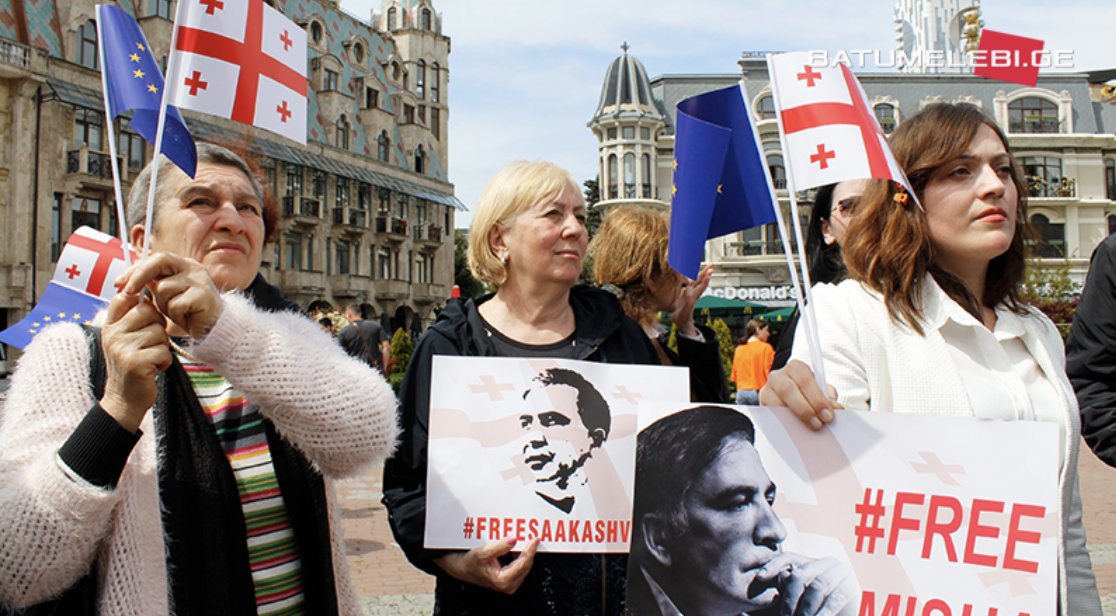
Credit: Batumelebi.ge
So imagine my surprise when Misha started showing up on my TikTok.
Old speeches over music. Construction sites. Batumi before and after. Police reform. Roads. Airports. Western leaders in Tbilisi. Clips about how quickly Georgia was changing. Videos arguing that people had been lied to about the “nine years.”
At first I assumed it was simply my algorithm. Then the videos kept coming. On Instagram too.
So I decided to get in touch with the people behind these videos to figure out their motivation.
@flagsasap gave me perhaps the cleanest explanation: Saakashvili is “the only politician who has aura.”
His family remembers the UNM period as a “golden age,” and Misha is hardly an obscure historical subject among his friends. According to him, it is difficult to discuss politics at university or among friends without Saakashvili coming up. He does not see Georgian Dream being defeated without Saakashvili or, at least, without a new figure of similar weight emerging from UNM.
Then there is GeorgianEditor, nineteen years old, who started making “aesthetic videos” about Saakashvili in 2023 because of Misha’s “genius and greatness.”
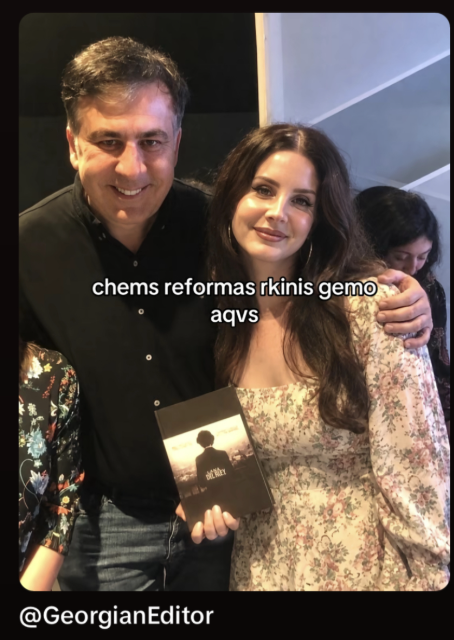
Translation: My reforms have the taste of Iron
He was born in 2007 and told me he was genuinely happy to have been born during the Saakashvili era. He also has friends his own age who share his political views, which he sees as part of a broader generational shift.
When I asked which other opposition politician he liked, the answer was short: “Only Mr. Saakashvili.”
Eighteen-year-old @mazniashvili1918 had a slightly different explanation. For him, making videos is one of the few ways he currently feels he can contribute to what he sees as a better future for Georgia. He grew up in a pro-Saakashvili family and said his family had faced hostility because of their political views.
Misha also comes up regularly among his friends. When I asked whether Saakashvili should return to power, he said Georgia needs him “like water.”
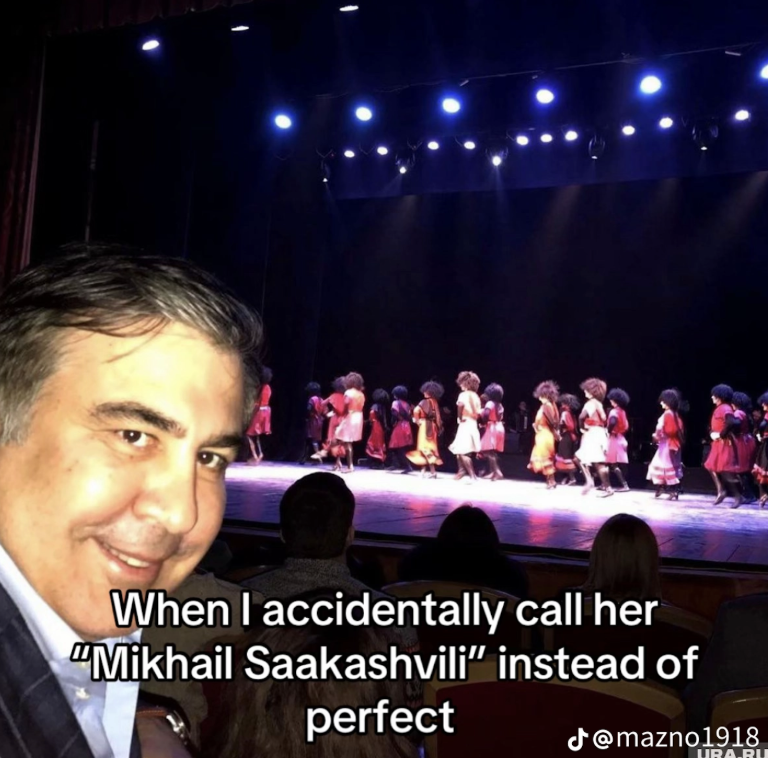
Then there are @kai_yma5, who is fifteen, and @editorishe, who is thirteen.
@kai_yma5 started posting because he wanted other people to know what he saw as the patriotism, policies, and results of the Saakashvili government. His family remembers that period through three things: security, order, and development.
More strikingly, he told me that several of his friends had become UNM supporters through his TikTok account.
Crime also came up immediately. He wants the criminal underworld gone and sees Saakashvili’s crackdown on thieves-in-law as one of the clearest differences between that period and Georgia today.
@editorishe arrived at Saakashvili from almost the opposite direction. His family speaks negatively about the UNM years. He became interested only after he started reading about Georgia after 1991, then politics more broadly, and eventually Misha.
At thirteen, he has neither a lived memory of Saakashvili’s presidency nor a pro-Misha family tradition to inherit. Yet when I asked whether any other opposition politician interested him, the answer was no.

Credit: Editorishe
That is what makes this more interesting than simple inherited nostalgia and Saakashvili himself has noticed it, too.
Writing from prison recently, he acknowledged that his traditional base includes loyal older women, but added that his popularity among schoolchildren had been growing. His explanation was that this support was not so much about him personally as about the ideas he represented: in his words, he had been building “the Georgia of the future,” while Ivanishvili had taken the country backwards.
Saakashvili obviously has a personal interest in that interpretation, but the teenagers I spoke to were describing something surprisingly similar.
And I think the Georgia they are growing up in explains a lot of it.
Take crime.
One of the defining projects of the Saakashvili government was destroying the power of the thieves-in-law: the Soviet and post-Soviet criminal bosses who had once operated almost as an alternative authority in Georgia. They settled disputes, controlled parts of the economy and the prison system, and carried enormous social prestige.
For the generation that grew up after the Rose Revolution, something that had once been revolutionary became normal: Criminals were not supposed to be authority figures.
That assumption feels less secure today. A 2024 study found continuing acceptance of criminal-subculture norms in Georgia, while thirty percent of respondents thought teenagers’ interest in that world had increased in the previous five years.
We hear stories of twenty-two-year-old Niko Kvaratskhelia, who was shot dead near his home in Tbilisi in 2021. His killing had been organised as revenge against his father, a thief-in-law, and as a way for the alleged organizers to strengthen their standing in the criminal underworld.
In 2025, businessman Levan Jangveladze, who has ties to the criminal world, was shot dead on Chavchavadze Avenue, one of central Tbilisi’s busiest streets that happens to be a couple of kilometers from my home. Georgian authorities later accused former Prosecutor General Otar Partskhaladze of organizing the contract killing. After his time as Prosecutor General, he obtained Russian citizenship, was sanctioned by the United States over alleged links to the FSB and, by 2026, was publicly leading a volunteer unit fighting on Russia’s side against Ukraine.
It is a trajectory that would sound excessive in fiction but the underworld stories have not stopped there.
Teenagers now grow up hearing these stories and more. Then they open TikTok and see archival footage of a government that made destroying criminal authority one of its political obsessions.
When @kai_yma5 tells me that the Saakashvili period means “security, order and development,” that starts to look less like blind nostalgia and more like a comparison with the country in front of them.
Crime is only part of that comparison. Imagine being fourteen, the country you know is restricting civil society, beating and imprisoning political opponents, weakening universities, losing Western organizations and drifting further away from the European future we were raised to expect.
Then on the screen is a Georgian president talking constantly about NATO and Europe. Western leaders are visiting Tbilisi. New airports and roads are opening. Criminal authorities are being arrested. The country appears to be moving somewhere, quickly.
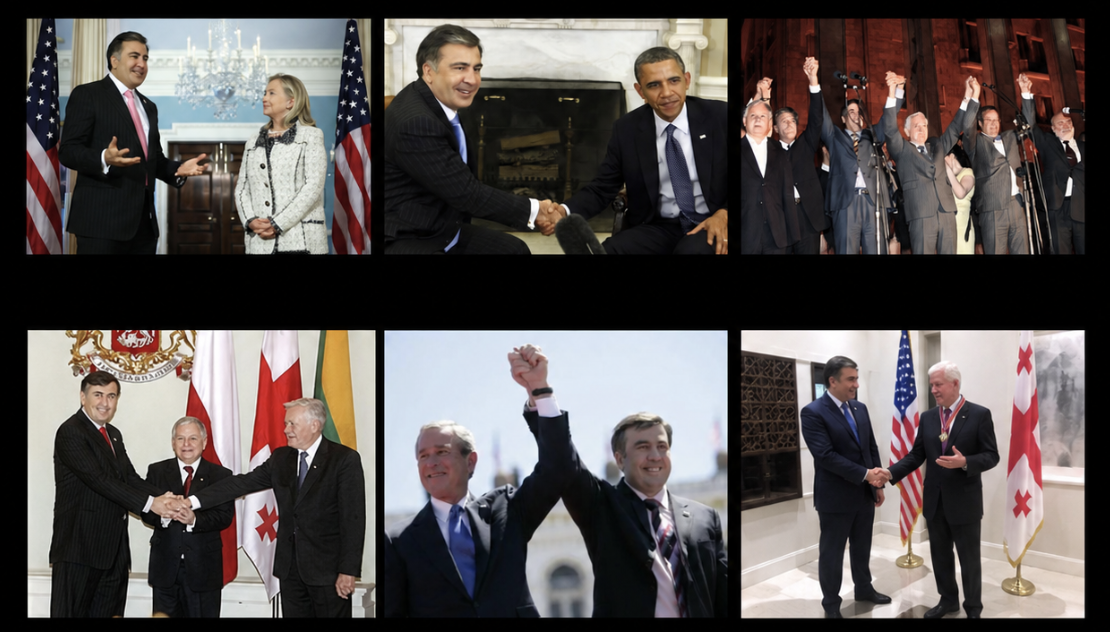
Source: Mikheil Saakashvili via Facebook
These teenagers are not simply nostalgic for a period they never experienced. They are comparing two political imaginations and one of them feels much clearer.
That also helps explain the “aura.”
The Georgian opposition has had fourteen years to produce another leader capable of commanding the kind of national attention Saakashvili once did. It has produced plenty of parties, coalitions, and capable politicians.
It has not produced another Misha.
Even from prison, he remains one of the people everyone else is forced to position themselves around.
The teenagers I interviewed did mention other politicians, particularly Zurab Japaridze and Levan Khabeishvili. But no one spoke about them in the same way.
For these young supporters, Saakashvili seems to represent something much bigger than an individual politician.
He represents direction.
His political project was very easy to understand: Georgia should become a modern Western state, escape Russia’s sphere of influence, and do both as quickly as possible.
The current opposition is much harder to summarize. After years of splits, boycotts, failed coalitions, and attempts to invent the long-awaited “third force,” it has still not produced a political leader of comparable magnitude.
So when a teenager says “Misha has aura,” I do not think they are only talking about charisma.
There is another irony here.
For fourteen years, Georgian Dream has built much of its political identity around Saakashvili’s “nine years.”
Don’t criticize our courts: remember the nine years.
Don’t criticize our police: remember the nine years.
Don’t criticize our political repression: remember the nine years.
Eventually, Misha appeared in almost every argument.
There is one problem with telling an entire generation, repeatedly, that one period in Georgian history was uniquely terrible.
Eventually they look it up.
And because they do not carry the same memories as their parents, they are judging what they find against the Georgia they actually know.
@editorishe can grow up in a family that dislikes Saakashvili and still arrive at him independently.
@kai_yma5 can introduce friends to UNM through TikTok.
And Misha can sit in prison for years and somehow remain more present in the political imagination of some teenagers than politicians who are free, campaigning and appearing on television every night.
For years, people assumed we would finally be the generation that moved beyond Saakashvili. Perhaps we still will. But first, some of us seem to be going back and checking whether the story we inherited about him actually adds up.
Maybe that is less about loving Mikheil Saakashvili than about what he has come to represent. A generation born after Georgia’s biggest transformation is now growing up during a period of regression. And when the present offers very little sense of a future, it is not particularly surprising that some of us have started looking for one in the past.
Edited by Veronika Raiffe (Columbia School of General Studies '28)