
Importing Fashion: The Burden of Abiding by Barometers of Beauty
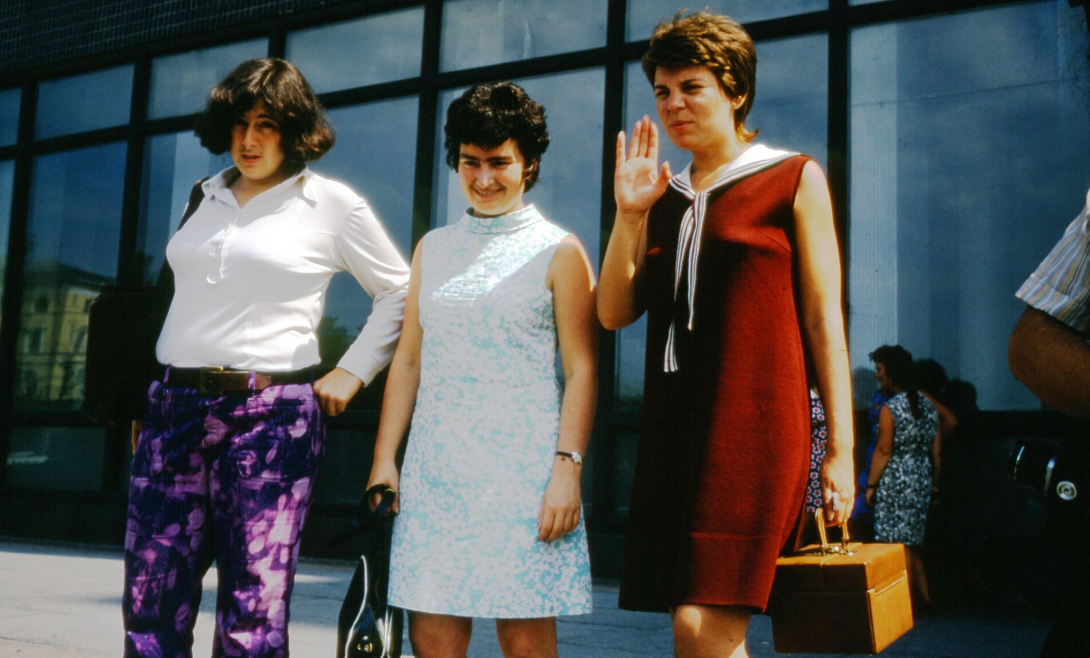
Women in Kyiv. Thomas Taylor Hammond. 1972
By Orion Fisher, Carleton College
Christianity was not the only “Christian” proscribed by the Soviet Union. In June 1959, Christian Dior made his first and only appearance in Moscow. Before Khrushchev’s Thaw that facilitated the opening up of the Soviet Union in the 1950s, being “in fashion” meant being purely practical, reasonable, modest, and somewhat uniform: Good taste was the “skill not to set oneself apart by overly smart or extravagant dress.” According to the norms set forth by the drive for kul’turnost’ (Культурность, meaning “to be cultured")in the early Soviet period, haute couture, or high fashion, impeded the progress towards a communist society, as fancy dresses and expensive suits were markers of class—exactly what was to be eliminated. The expectations were not equally shared by the genders; the duty to reject fashion and flirtation primarily fell on women, who, throughout the early part of the century, were seen as more likely to be burdened by such vices.
In this paper, I seek to describe how fashion conformity was added to Soviet women’s growing responsibilities. Veshchism (Вещизм, meaning literally “thing-ism” or “materialism”), specifically the fixation on dress and attractiveness, I argue, contributed to the already oversized workload that encumbered Soviet women, creating a triple burden. This is revealed through an examination of various different newspapers and journals that published women’s personal anecdotes and experiences with fashion. To demonstrate how beauty labor itself inherently burdens women in a society obsessed with image and appearance, as was experienced in the Soviet Union during the Thaw, I incorporate gender theory. The trajectory of this paper begins in the early Soviet period, in which Christian Dior could certainly not be considered cultured. It continues past Stalin’s death in 1953, and contemplates the leadership’s paradox that, while discouraging overconsumption and celebrating disinvestment from material goods, the state’s attitude towards prestige and luxury became surprisingly liberal. Finally, it culminates in 1959, when Soviet fashion houses invited Christian Dior, the leading French fashionista, to put on a runway in Moscow, showcasing European designer luxury to the Soviet citizenry. The exposure to the West that the 1950s and 60s brought created a distinctly-Soviet style of consumerism defined by obsession with Western goods and trends.
Beauty labor—putting on makeup, appealing to the male gaze, and, in general, conforming to idealized femininities—is a disciplinary force that regulates behavior. Compounded by the tendency to punish those who fail to “do” or “perform” their gender “correctly,” according to normative standards, women’s bodies are more highly regulated than men’s, therefore adding another aspect of performativity and consequence into their lives (Butler 178). When genders are performed “incorrectly,” or when they elude “cultural intelligibility,” they appear as developmental failures (Butler 24). Women, to whom the standards are most stringently applied, therefore, have to play by a different set of rules than men.
The periods of scarcity during the Great Patriotic War provided few opportunities for women to indulge in luxury and elegance. The laws of kul’turnost’ dictated that taste was defined not by bourgeois fashion standards, but by mediated proletarian behavior. From this arose the stereotypes that Soviet fashion was a “grey mass” controlled by the state. Though this is not nearly true—the Soviet House of Fashion opened in 1935 and produced hundreds of designs and templates for Soviet men and women—Soviet fashion indeed could not compete with French or Italian styles in the realm of extravagance and cutting-edge luxury. Soviet fashion competed on a different measure than Western fashion. Instead of lavishness, it was rationality that dictated what was a la mode.
Though, as the USSR rebounded from economic devastation after the war and opened up to Western influence, Soviet-style consumerism burgeoned. “Thoughts of shopping intrude[d] into every corner of a woman’s existence,” and beauty, more than before, could be levied as aesthetic capital. It became “impossible to deny a woman the yearning to be attractive,” one magazine wrote (Current Digest 11). Foreign goods exhibitions held in Moscow only aggravated this trend toward Western consumerism. From 1959 (the first of a long line of shows) to 1963, over 8.7 million attended a dozen shows put on by foreign nations. On top of this, foreign fashion shows attracted large numbers of interested guests. Christian Dior’s show in June 1959, saw over 10,000 attendees, with almost triple the estimated demand for tickets. Though this show was not the sole impetus for the fascination with fashion, it came during a time when Soviet citizens were becoming more accepting of high fashion and the malleable social indicators that came with it, and thus it encouraged this existing trend.
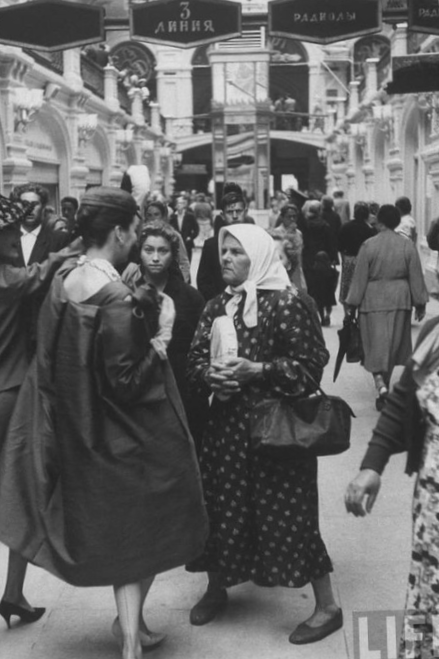
Reports show that many women became more conscious of how they presented themselves in public. TheNew YorkTimes reported in 1967 that “the new woman is concerned about where she lives and how she lives, and what she looks like. She has decided that she looks better in high-heeled shoes, lipstick, brightly colored clothes and that her hair should be soft and feminine.” Similarly, they reported, presumably no Uzbek woman “ever stepped out of the house without first applying their eye make-up.”
The conflation of beauty and consumption represented the commodification of aesthetics for Soviet women. Government-sponsored books, magazines, and journals burgeoned across the Union. Some were more high end, advertising Soviet-style high culture, such as Zhurnal Mod (Журнал Мод, meaning “Fashion magazine”) while others, such as Rabotnitsa (Работница, meaning “Woman Worker”) and Sovetksaia Zhenshchina (Советская Женщина “meaning, Soviet Woman”), were not specifically tailored to showing off extravagance. Instead, these magazines made fashion easily accessible, providing cutouts and instructions for sewing at home.
Despite the accessibility of some styles, there was a persistent yearning for what was not had. As Georg Simmel describes, fashion satisfies both the demands not only for social adaptation but also for differentiation. Fashion by its very nature insists that the individual get ahead of the pack.
As women were seen as the primary consumers of fashion in the Soviet Union and whom novel styles were primarily designed for, consumption and individuality were naturalized as female tendencies. The natural desire to stand out amidst the pack inculcated the popular, individual demand for daring dresses, spike heels, and high-quality, traditional, national patterns (Strong 39-40). Some journals even praised French haute couture, despite its capitalist veneer: “Features of elegance, good taste and very careful use of fashion are characteristic of all Parisians… Despite the fact that the modesty and exquisite simplicity of clothes are common to the world and are often the criterion of good taste, the words ‘Parisian fashion’ mean something completely different” (Efremova, “Moda dvukh stolits” 34).
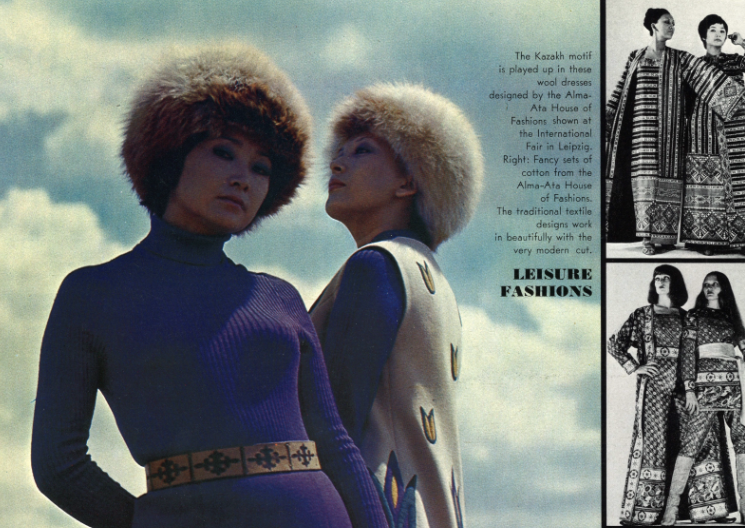
The acceptance of high end dress created a paradox for the Soviet state. If the socialist moral structure—and with it, the Soviet Project itself—were to be maintained, the exploitation of abundance would have to be reigned in and placed under state control once again. Despite Khrushchev’s declaration that living standards were on the rise and luxury would soon follow, there was still not nearly enough for every Soviet woman to have an elegant wardrobe. And still, even if high fashion became accessible, by the very principles of fashion, as Simmel outlines, it would no longer be considered “fashionable,” and certainly not “high fashion.” Its exclusivity was inextricable from its appeal, by definition violating the Soviet principles of equality of both outcome and opportunity.
We see, therefore, that a hierarchy of fashion became inevitable and was exacerbated by the post-war acceptance of Western designer tendencies to stand out. Soviet and Russian particularisms further elucidated that “there is a connection between fashion and behavior,” as Rabotnitsa reported (Efremova, “Moda i my” 88). Russianness, it is said, is distinctly and discursively linked with beauty. Women, and Russian women specifically, in the Soviet period reported feeling pressured to live up to a perceived national standard that to be Russian is to be beautiful. Doing so meant enduring more beauty labor than before just to fit in (and ironically, as fashion dictates, to stand out).
A letter to the editor in 1972 expressed a similar sentiment: “Youngsters sometimes go from trying on foreign fashions to trying on foreign ideas” (Maleto 14). Similarly, it is said that “according to an existing cultural stereotype, [outward] appearance reflects one’s inner self, and bad taste means bad inner self.” Demonstrably, many women during the Soviet period conceived of fashion, and taste more broadly, as a window to the soul. According to Lida, a young woman from Moscow, this conception had material effects on women and young girls. Interviewed in 1983, her story demonstrates the social effects of having poor clothes.
The fact is that a lot of nursery personnel seem to judge people according to the way they’re dressed. Once when I came in my ugly clothes the people in charge said that unfortunately there was no place [for her child], even though I was at the head of the list. Then another woman came in dressed in a fur coat, and they offered her caramels and said that of course she could enroll her child. Things like that happened to me several times.
The connection established between fashion and one’s true self facilitated the creation of a hierarchy of women’s bodies. This was not only based on fashion sense, but also income. Though the Soviets purported to have eliminated class, or at least had established a dictatorship of the proletariat, they certainly did not eliminate wealth inequality. Clothing, especially public-facing dress, revealed the life of the wearer. The cause of poor clothing, whether it be bad fashion sense or poverty, didn’t matter as much as the significance: a moral or personal failing. It is this concept through which a hierarchy of (women’s) bodies was ingrained in Soviet gender canon.
Women who did not conform to fashion standards—and thus, gendered standards—and those who were not at the top of the hierarchy carried extra baggage that precluded them from heavily-weighted social (and often material) capital. Because, as some Soviet women said, fashion was inherent to womanhood, to ignore fashion trends, or to fail to meet their expectations, meant the abdication of one’s gender. Interviews conducted for Soviet Women in 1983 demonstrate that femininity, and its multiplicitous meanings, is essential to women of every age, origin, and status. Liza said, “Femininity is that luminous, essential something that separates us from the animals.” Sonya described that “it’s also important to know that you’re a woman — soft, calm, considerate.” “Femininity,” as Natasha put it, is “kindness, sincerity, gentleness, the touch of the artist, a capacity for intimacy, a talent for getting flowers to bloom.”
Those women who put in the extra time and effort to conform similarly took on a third burden on top of the omnipresent double burden of domestic and paid labor. Financial and time restrictions limited the scope of those who could realistically reach that standard. As consumption and beauty became tied together, fashion’s role as a marker of wealth solidified, undermining the meritocratic Soviet Project.
The importation of fashion from the West following the opening up of the Soviet Union in the 1950s inculcated and catalyzed new conceptions of fashion that prioritized physical beauty and even privileged wealth over merit. Emerging from the dour of early Soviet fashion, this new Western style at the same time beautified Soviet women and saddled them with a third burden, one which, when gone ignored, cascaded into further social discipline. To be Russian meant to be beautiful, and to be beautiful meant to engage in the discourse of fashion, giving into the paradox of individuality and excess.
Edited by Effie Gao (Columbia College '28) & Jay Jacobson (Columbia University School of General Studies ‘28)