
Measured Talents: Poetry, Agency, and Women's Education in A Double Life
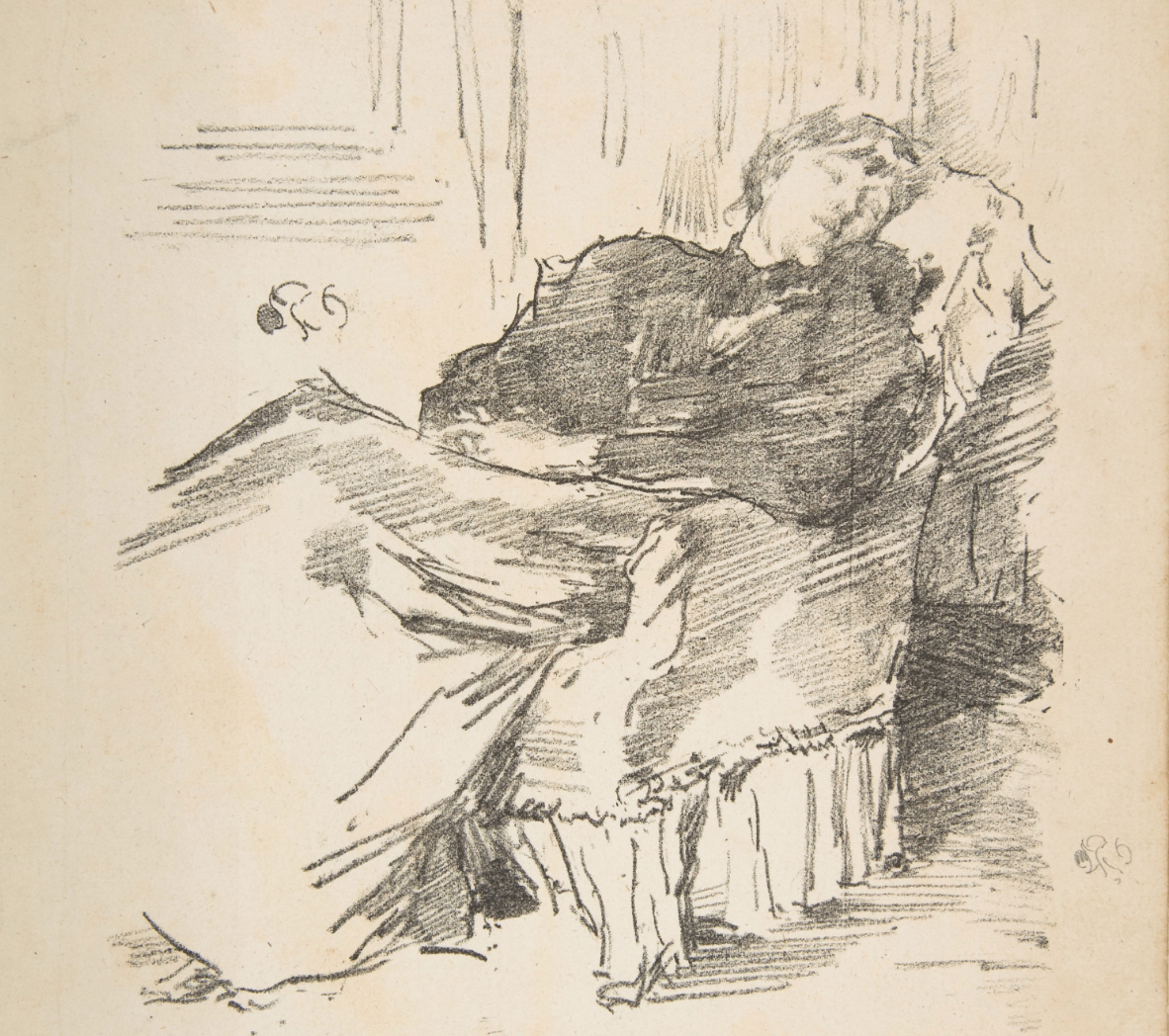
La Belle Dame Endormie (The Beautiful Woman Asleep) by James McNeill Whistler. The Metropolitan Museum of Art. 1894.
By Ava Lyon-Sereno, Barnard College, Columbia University
Karolina Pavlova’s 1848 novel A Double Life provides an incisive commentary on women's education and societal agency. Pavlova, a largely unrecognized Russian female author, got her literary start translating poetry, then writing it herself. Her male peers thought Pavlova, as a woman poet, ridiculous. While many leading figures in Russian literature and poetry attended the salon she hosted—writers like Alexander Turgenev, Pyotr Chaadaev, Alexander Herzen, and Ivan Aksakov—she and her work were regularly mocked. Her original poetic works were “cold, heartless, and remote” to critics, and even when their meticulous clarity was appreciated by her male poetic peers, it was with the caveat that the author herself was haughty and “theatrical.”[1]
The fact that Pavlova's novel has survived to the contemporary day is remarkable due to its having a female author and so directly confronting the gender-based disparities in 19th-century Russian education. Over seventy years before Alexandra Kollontai would publish Communism and the Family, Karolina Pavlova’s novel A Double Life would raise similar concerns: that reliance on family and societal structures that seem fundamental is actually a violation of people's (particularly women’s) relationship to themselves. However, Pavlova can only point out her concerns and doesn’t have a replacement framework to offer. Many decades later, Kollontai recognizes the same issues, but can propose Marxism as a solution. Pavlova utilizes an unusual format of prose chapters ending in poetic verse to portray the complexities of women’s education and its effects on high society. Each chapter uses prose to follow the main character through her conscious life in high society, transitioning to metered poetry for her dreams and unconscious state. Pavlova uses the exoskeleton of a society novel—a novel genre that explores issues in high society, typically focusing on themes of marriage, romance, and inheritance (well-known examples would include the works of Jane Austen)—to explore deeper societal issues. Thus, Pavlova is able to express her thoughts on women being denied a real education and agency in their lives in an easily recognizable format for readers at the time. While A Double Life contains the typical tropes of a society novel, like meddling mothers, a bosom companion, and a poor but romantic male love interest, these are used as a legible hook into Pavlova's tragic realism as she explores the effects restrictive social structures enact upon a young woman’s psyche.
A Double Life centers on Cecily, a naïve high-society girl, who encounters a mysterious figure in her dreams. This figure issues dire warnings about her curtailed agency—claiming Cecily faces a “difficult path” that she will be “defenseless and alone” —and encourages her to pursue her heart instead of following society's expectations.[2] The unconscious affinity Cecily has for poetic verse is depicted as a romance with Poetry personified and is used as a foil for Cecily’s conscious-world romance with her suitor, Dmitry.
When the reader first meets Cecily, she is preparing for bed and thinking about the summer ahead with her friends, imagining, “that they would take walks together and dance and go horseback riding.”[3] While considering these plans, a “strange and inexplicable” thought keeps bothering Cecily, “a heavy and persistent feeling, as if she were being made to guess a riddle, find a word, remember a name and was not able to...”[4] Cecily’s vague discontent before falling asleep prefaces her first dream, where she meets Poetry: a mysterious figure, with a “commanding gaze” who stands “powerful and stern” in a moonlit garden.[5] Cecily walks towards the figure and stands before him; though no dialogue is exchanged, the setting for her unconscious dream world has fallen into place. This poem establishes Poetry as a person Cecily can interact with, and provides a non-physical space where she is free to explore her thoughts, unlike the real world.
During the second chapter, Cecily and her mother, Vera, visit Cecily’s best friend, Olga, and her mother, Madame Valitskaia. While Cecily and Olga discuss romance and attire in Olga’s room, Vera and Madame Valitskaia discuss the proper methods for raising a young woman in high society. They conclude that a technique of rigid sheltering, whereby the mother intentionally curtails her daughter’s intelligence and agency—by limiting negative influences like powerful literature or poetry—is the most effective strategy to raise a proper young woman. Later, Vera is described as “very proud” of how she raised Cecily, as it “had been accomplished not without difficulty, because it took time and skill to destroy in her soul its innate thirst for delight and enthusiasm.”[6] This tongue-in-cheek critique of women’s education is a running motif in the book, with Pavlova’s incisive argument against these family and social norms illustrated in Cecily’s own actions (or lack thereof).
In Cecily’s dream that night, she speaks with the mysterious figure, who says that Cecily called for him and that he will be faithful to her, beginning the overtures of a romantic courtship. He prods Cecily to consider real life versus her dream world: “Perhaps everything there was false, / Perhaps only here you are awake”.[7] Reminding the reader of the mothers’ earlier discussion, he calls Cecily a “prisoner of society's world”, adding, “That small-souled being isn't you. / They have fettered you from childhood, / Have swaddled your free mind,”.[8] Here, the reader, alongside Cecily, is given a counternarrative to the mothers’: that the deliberate coddling and control over young women is a negative thing, leaving them without the common sense they need to navigate the world. Pavlova portrays Poetry as an antidote, a force that will lift Cecily out of the envelopment of ignorance with its beautiful power, developing her mind and talents to their full potential. For Kollontai, however, a systemic issue requires a systemic response: the liberation and education of all women, not just one. She states, “a woman must…seek and find support in the collective and in society”.[9] An individual woman leaving the constraints of a capitalist society can’t be accomplished simply through growth and exercise of artistic talent, but through a total restructuring of the relationships and culture that demand her ignorance in the first place.
In the middle stanzas of chapter two’s poem, Poetry continues, explaining that he will only visit Cecily at night in her dreams—“I will not lift the veil / From your eyes, in that land of the blind”—and she won’t consciously remember him in the real world: “The traces of my love will disappear”.[10] These stanzas succinctly establish the reader’s mechanical understanding of how Cecily’s dream and real worlds interact, as well as continuing a romantic parallel between Cecily and Poetry, and Cecily and Dmitry. Poetry claims that, “With the mysterious force of a kiss / I will lift the shackles from your soul,”.[11] This contrasts with the final chapter, when, as Cecily is about to marry Dmitry, she receives a bracelet from him whose “lock” is “fastened” around her wrist.[12] The “chain of sorrow” that is marriage within a capitalist society is portrayed physically, reemphasizing the lack of agency Cecily is further consigning herself to.[13] Poetry’s dream-world love frees her, signifying true compatibility, while Dmitry’s real-world love shackles her, cementing the veil of ignorance over Cecily’s eyes.
Chapter three describes a ball thrown by Vera, who has one of the guests, a poet, recite one of his works toward the end of the night. Crucially, this marks the first time Cecily has heard poetry being performed in the real world. She retires to bed feeling “somehow strange and awkward” and repeating some of the lines the poet had recited.[14] The curtailing of her imagination is described in vivid prose: “Now, at eighteen, she was so used to wearing her mind in a corset that she felt it no more than she did the silk undergarment that she took off only at night. She had talents, of course, but measured ones, decorous ones.”[15] Poetry was described to her as “something wild and incompatible with a respectable life,” but after hearing it performed, “there awakened in her a new and obscure sympathy,” and “this unexpected sympathy almost frightened her.”[16]
Poetry is a disturbance to her “respectable life”, one which only occurs in her dreams, after she has taken off her physical corset and her mind is released from its mental corset. As she falls asleep, “rhyme sounded in her again; she heard poetry and…she suddenly thought that she too could speak in song.”[17] The “sympathy” Cecily feels represents her unrealized desire for poetry, a delicate narrative suggestion that “she too could speak in song,” and is something she could be truly skilled at. However, in a society where poetry is “incompatible” with respectability, it’s not an option for her. As a young middle-to-upper-class woman, Cecily’s entire life is dependent on being respectable, on being limited, self-contained, measured enough to secure a wealthy husband. What Kollontai describes as “the old family”, where “the woman had no will of her own”, is exactly the world Cecily lives in, and what Pavlova was pushing back against in her portrayal of that society as negative.[18]
These expectations and restraints Cecily has internalized are not unbendable, however. In Chapter four, on a group horse riding trip, Cecily unexpectedly whips her horse to “top speed”, overcome with the feeling that, “She suddenly wanted to gallop away from life's imprisonment, from all dependencies, from all obligations, all necessities.”[19] Crucially, Cecily’s first expression of freedom after she hears Poetry’s “improper delights” is galloping on her horse, something commonly associated at the time with sexual licentiousness and immodesty in young women. In this moment, Cecily and her horse mirror each other: both are domesticated, docile creatures, but pierce through their trained obedience for a moment to experience freedom. While physical and not intellectual, Cecily still does something she chooses to do, responding to an impulse originating within herself instead of the directions of people controlling her.
In chapter six, Cecily celebrates her birthday with a lavish party. During the festivities, she and Dmitry flirt—unbeknownst to either of them, this dalliance is a result of the machinations of Madame Valitskaia—and Dmitry kisses her hand. Cecily prepares for bed, idly thinking about her love for Dmitry yet feeling “inexplicably somber.”[20]In her dream that night, Poetry speaks to her, imploring Cecily to “awake” into her dream world and insisting, “It is in me your soul believes, / Me that you love, not him.”[21] The waking world is an “evil dream”, a “strange land” where Cecily is not her true self.[22] From Poetry’s perspective, Cecily is only truly awake and alive in her dreams, where she spends time with Poetry and rejoices in verse. The real world is only a strange and evil place, where she is shuffled along by the choices of everyone but herself, and so restricted she cannot even think about exerting her own will beyond a brief horseback ride. The tragedy of A Double Life is that, while the reader and Poetry understand her unconscious and her unrealized love for the art form, Cecily never consciously does. In the real world, she drifts along, living a life devoid of the meaning and passion she subconsciously craves. Only when Cecily is alone does she occasionally feel vague discontent or pensiveness she can’t understand.
In the next chapter, Cecily and Dmitry are engaged. She falls asleep overjoyed at the thought of marrying her true love, only to be arrested by the sight of a melancholy Poetry awaiting her in the dream-world garden. She lambasts him, crying out: “Sorrowful force…You light a ray of thought in me. / Leave me alone, stern spirit! / You grow sadder and gloomier; / I fear your revelations, / Your pitiless love.”[23] The full comprehension of how meaningless her life is, how little control she has, and how much she does not know is so unbearable to Cecily that she implores her ‘suitor’ to abandon her, thus rejecting the possibility of deeper understanding of both herself and society at large. Poetry, while an empowering and meaningful partner (or art form), is also conflict-inducing. Cecily, raised without critical thinking skills, would rather hide in the stability of ignorance than let “a ray of thought” penetrate her mind.[24] Rejecting Poetry in her unconscious mind, Cecily chooses her real-world suitor, Dmitry. Dmitry is poor, at least by the standards of the upper class, but pursues Cecily at the urging of Madame Valitskaia (who wants beautiful Cecily ‘off the market’ so Olga can have better marriage prospects). The “elements of material calculation” that Dmitry considers (like Cecily’s wealth)—which Kollontai argues ultimately “cripple family life”—take on a different form in Cecily.[25] With her firmly curtailed lack of common sense or knowledge of herself, she believes Dmitry is truly in love with her and “dreamed of how sweet it would be to live in poverty”.[26] While she occasionally notices “an ugly dress” or an “old, clumsy carriage,” Cecily believes these things are a result of “ignorance, a lack of taste.”[27] She is wealthy enough and sheltered enough that she cannot imagine not being able to afford the luxuries of her regular life: “...to not be able to order a fashionable dress and own a decent carriage? What kind of poverty does not allow even that?”[28] A Double Life is thus able to mock the absurd coddling of young women, while still concluding, like Kollontai does, that the relationships enabling these outcomes are detrimental.
The mistake Cecily is making by marrying Dmitry becomes increasingly apparent as the book enters its last chapters. The preparations for the wedding are likened to the “accidentally deafening music and beating of drums by which soldiers are led into mortal combat.”[29] The night before her wedding, Cecily had her last dream of Poetry. He yields Cecily to his romantic rival Dmitry and her own ignorance, telling her: “So, go as you've been sentenced, / Strong in faith only, / Not hoping for support, / Defenseless and alone.”[30] The last vestiges of deeper meaning in her life, of connection to the ‘real’ world of her dreams, disappear. Cecily’s unconscious but present talent for poetry is demonstrated throughout her dreams, but will no longer be something she remembers as meaningful, as an unrealized outlet of creation and expression.
Before she walks down the aisle, Cecily is given a bracelet as a gift from Dmitry. While Olga puts the bracelet on her, Cecily whispers, “So, go as you've been sentenced, / Defenseless and alone...”[31] Olga is surprised and asks what she is saying, and Cecily responds that she doesn’t know, that "It's some song that has been going round in my head. I can't remember where I heard it."[32] Olga calls it nonsense, and Cecily does not respond. Crucially, Cecily does not remember or repeat the line in the original stanza “Strong in faith only”, as she no longer has faith in Poetry to rely on. Furthermore, the initial implication of “sentenced” is that of a prison sentence, a judicial order from Poetry. The connotation of Cecily’s gifted bracelet being locked around her wrist like a pair of shackles adds to this initial metaphor.
As Cecily is ‘locked’ into a life of ignorance and suffering to come, the implication is also that of a death sentence. When she stands at the altar, Cecily is “as pale as a corpse”, looking melancholy and unsure, while the reader is prompted to consider whether a life lived in ignorance and suffering is not a death sentence in itself.[33] Ultimately, I propose that A Double Life ends in a marriage scene—typically a joyous event, but here with darker undertones exposed—because this story is a tragedy. To Pavlova, there is nothing she can do except critique the issues she sees in society and its treatment of women without the hope of a different future. Kollontai had the benefit, many decades later, of furthering a vision for a communist society that includes women. Kollontai’s argument that “the woman in communist society” will depend upon work for support instead of “upon her husband” is able to both critique the issue of women’s inequality and provide an actionable path to change that inequality.
Works Cited
Kollontai, Aleksandra. Communism and the Family. Translated by Alix Holt, Allison & Busby, 1977.
Pavlova, Karolina. A Double Life. Translated by Barbara Heldt, Columbia University Press, 2019. https://doi.org/10.7312/pavl19078
[1] Pavlova. 2019. Page viii, x.
[2] Pavlova. 2019. Page 70, 114.
[3] Pavlova. 2019. Page 7.
[4] Pavlova. 2019. Page 7.
[5] Pavlova. 2019. Page 8, lines 23 and 29.
[6] Pavlova. 2019. Page 28.
[7] Pavlova. 2019. Page 19, lines 24-25.
[8] Pavlova. 2019. Page 19, lines 26, 29-31.
[9] Kollontai. 1977.
[10] Pavlova. 2019. Page 20, lines 47-48, 50.
[11] Pavlova. 2019. Page 20, lines 59-60.
[12] Pavlova. 2019. Page 116.
[13] Kollontai. 1977.
[14] Pavlova. 2019. Page 28.
[15] Pavlova. 2019. Page 29. My emphasis added.
[16] Pavlova. 2019. Page 29.
[17]Ibid.
[18] Kollontai. 1977.
[19] Pavlova. 2019. Page 37.
[20] Pavlova. 2019. Page 68.
[21] Pavlova. 2019. Page 70, lines 7, 27-28.
[22] Pavlova. 2019. Page 70, lines 5-6. [23] Pavlova. 2019. Page 88, lines 13-20. [24] Pavlova. 2019. Page 88.
[25] Kollontai. 1977.
[26] Pavlova. 2019. Page 93.
[27]Ibid.
[28]Ibid.
[29] Pavlova. 2019. Page 92.
[30] Pavlova. 2019. Page 114, lines 65-68. [31] Pavlova. 2019. Page 116.
[32]Ibid.
[33] Pavlova. 2019. Page 117.